
Edessinae
Genus Guides
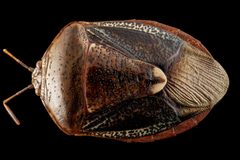
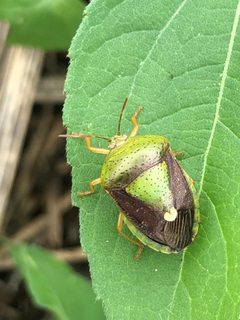
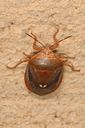
1Edessinae is a of shield bugs (Pentatomidae) comprising approximately 10 and over 200 , primarily distributed in the Neotropical region. The subfamily is characterized by distinctive morphological features of the male and female genitalia, including modified pygophores, gonocoxites, and internal reproductive structures. Recent taxonomic revisions have elevated several former subgenera of Edessa (Hypoxys, Pygoda) to genus level and established new genera including Grammedessa, Plagaedessa, Paraedessa, Odara, and Apheledessa. Species identification relies heavily on genitalic due to frequent convergence in external body form.
Pronunciation
How to pronounce Edessinae: /ɛˈdɛsɪnaɪ/
These audio files are automatically generated. While they are not always 100% accurate, they are a good starting point.
Identification
Edessinae can be distinguished from other Pentatomidae by the following combination of characters: metasternal process with bifurcation (branches narrow, long, with acute apices in many ); abdominal placed laterally, not aligned with ; male pygophore often large relative to body size with various modifications including excavated rim, blade-like processes, or lateral expansions; female gonocoxites 8 and laterotergites 8 typically punctured; and internal genitalia with distinctive configurations of the capsula seminalis, ductus receptaculi, and gonapophyses. Humeral angles are frequently laterally projected and slightly dorsoventrally flattened.
Images
Distribution
Neotropical region, ranging from Mexico and Central America through South America to northern Argentina and the Atlantic coast of Brazil. Specific distribution records extend to Rica, Panama, Colombia, Venezuela, Ecuador, Peru, Bolivia, Brazil, French Guiana, Suriname, Guyana, Trinidad and Tobago, and Puerto Rico.
Similar Taxa
- AsopinaeBoth are of Pentatomidae, but Asopinae are predatory with forelegs and lack the characteristic genitalic modifications of Edessinae; Edessinae lack the predatory adaptations of Asopinae.
- PentatominaeLargest and most diverse of Pentatomidae, but typically has abdominal aligned with and lacks the specialized metasternal process and genitalic structures diagnostic of Edessinae.
Sources and further reading
- BugGuide
- iNaturalist taxon
- NCBI Taxonomy
- Grammedessa, a new genus of Edessinae (Hemiptera: Heteroptera: Pentatomidae)
- A new genus and new species of Edessinae (Hemiptera: Heteroptera: Pentatomidae)
- A new species group in Edessa Fabricius, 1803 (Heteroptera: Pentatomidae: Edessinae)
- Paraedessa, a new genus of Edessinae (Hemiptera: Heteroptera: Pentatomidae)
- Cladistic analysis and biogeography of Brachystethus Laporte (Heteroptera, Pentatomidae, Edessinae)
- Description of a new group of species of Edessa (Hemiptera: Pentatomidae: Edessinae)
- Seventeen new Species of Hypoxys Amyot & Serville, 1843 (Heteroptera: Pentatomidae: Edessinae)
- Odara, a new genus to Edessinae (Hemiptera, Pentatomidae) with Eleven New Species
- Description of six new species to Grammedessa Correia & Fernandes, 2016 (Heteroptera: Pentatomidae: Edessinae)
- Revision of Pygoda Amyot & Serville, 1843 stat. rest. (Heteroptera: Pentatomidae: Edessinae) with description of four new species
- Reevaluation of the type species and redescription of five species of Edessa (Heteroptera: Pentatomidae: Edessinae)
- Description of Apheledessa gen. nov. (Hemiptera: Heteroptera: Pentatomidae: Edessinae) with two new species from the Brazilian Atlantic Forest
- Description of a new group of species of Edessa Fabricius, 1803 (Hemiptera: Pentatomidae: Edessinae) with translucent spot on hemelytra
- A new species group to Edessa, the E. ovina group, with description of a new species (Heteroptera: Pentatomidae: Edessinae) from Brazil
- Proposition of a new species group in Edessa Fabricius, 1803 <br />(Hemiptera: Heteroptera: Pentatomidae: Edessinae)
- First report of aberrant sperm in Edessinae and analysis of the male reproductive system of Edessa rufomarginata (De Geer, 1773) (Hemiptera: Pentatomidae).