
Stiretrus
Laporte, 1833
anchor stink bugs
Species Guides
1- Stiretrus anchorago(anchor stink bug)
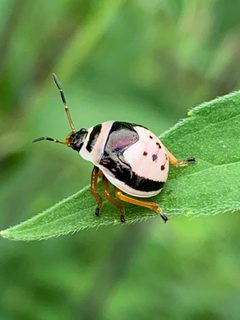
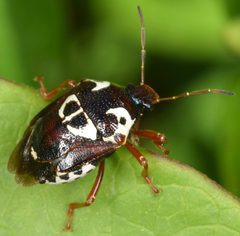
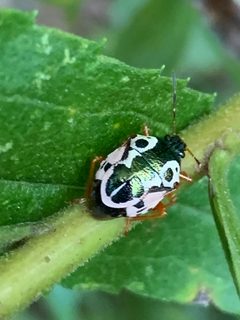
Stiretrus is a of predatory stink bugs in the Asopinae, Pentatomidae. occur in the Americas, with records from North America (USA, Canada) and South America (Brazil, Suriname). The genus includes at least eight described species, with S. anchorago (anchor ) being among the better known. Members are of other insects, with documented specialization on cassidine beetles (Chrysomelidae) in some species. Some species exhibit striking color and possible mimicry with their prey.
Pronunciation
How to pronounce Stiretrus: /ˈstaɪ.rɛ.trʊs/
These audio files are automatically generated. While they are not always 100% accurate, they are a good starting point.
Identification
Asopinae placement distinguishes Stiretrus from phytophagous pentatomid ; however, -level identification within the genus requires examination of specific morphological characters not detailed in available sources. of S. decemguttatus show up to 17 color pattern variations based on three basic marking sets, which may complicate visual identification.
Images
Habitat
Vacant lots and vegetation patches in urban and semi-urban areas; specifically recorded from areas with Ipomoea asarifolia (Convolvulaceae) on Marajó Island, Brazil. Activity appears concentrated during rainy season in tropical regions.
Distribution
Americas: USA (including Vermont), Canada, Brazil (Pará State—Marajó Island, Maranhão State—São Luis Island), and Suriname.
Seasonality
In tropical regions (Brazil), and nymphs observed mainly during rainy season; temperate (S. fimbriatus) overwinter as adults.
Diet
Predatory; documented prey includes cassidine beetles (Chrysomelidae: Cassidinae), specifically late-instar larvae of Botanochara sedecimpustulata and Zatrephina lineata. Attacks all developmental stages of prey (, larvae, pupae, ), with preference for late-instar larvae. No laboratory preference shown between cassidine when both offered.
Host Associations
- Botanochara sedecimpustulata - preyCassidine , late-instar larvae preferred
- Zatrephina lineata - preyCassidine , late-instar larvae preferred
- Ipomoea asarifolia - associated vegetation plant of prey beetles; site of -prey interactions
- Sida sp. - oviposition siteDry calyxes used for clutch deposition and camouflage
- Cylindromyia fumipennis - Tachinid fly of S. fimbriatus
Life Cycle
, five nymphal instars, . S. decemguttatus: egg incubation 6 days; nymph stage ~16 days; adult stage ~22 days; total ~44 days. S. fimbriatus: egg development ~9.5 days; nymphal instars average 5.1, 4.3, 4.1, 4.3, and 8.2 days respectively. Nymphal instars separable by width or pronotal width with no overlap.
Behavior
Deposits clutches in dry calyxes of Sida sp. for camouflage. Attacks all prey life stages but preferentially targets late-instar larvae. Exhibits color : S. decemguttatus display up to 17 color patterns from three basic marking sets; nymphs show three color patterns independent of adult patterns. Possible mimicry with chrysomelid beetles associated with Ipomoea asarifolia.
Ecological Role
of cassidine beetles; potentially plays fundamental role in coexistence patterns of prey . increase follows seasonal abundance of prey larvae. May contribute to of cassidine populations.
Human Relevance
Potential agent for cassidine beetles (Chrysomelidae), which include some agricultural pests. No direct economic importance documented.
Similar Taxa
- PodisusAlso in Pentatomidae:Asopinae; both are predatory stink bugs with similar and nymphal development patterns. S. fimbriatus and P. placidus have been studied together, sharing similar nymphal instar duration and .
- PerillusAnother Asopinae with predatory habits; some show similar color patterns and prey on chrysomelid beetles, potentially causing confusion in field identification.
More Details
Color polymorphism and mimicry
S. decemguttatus exhibits extensive color with up to 17 color patterns. Some patterns resemble cassidine beetles (Botanochara, Zatrephina) that feed on Ipomoea asarifolia, suggesting possible participation in a mimetic ring. This polymorphism may complicate field identification and could represent an anti- or hunting strategy.
Population dynamics
time (T) of 12.65 days and intrinsic growth rate (r) of 0.25 reported for S. decemguttatus under laboratory conditions. increase in the field follows seasonal increase in prey larval abundance.
Sources and further reading
- BugGuide
- Wikipedia
- GBIF taxonomy match
- iNaturalist taxon
- NCBI Taxonomy
- Biology of a Predaceous Stinkbug, Stiretrus anchorago, (Hemiptera: Pentatomidae)
- IMMATURE STAGES AND BIOLOGY OF PODISUS PLACIDUS AND STIRETRUS FIMBRIATUS (HEMIPTERA: PENTATOMIDAE)
- Developmental biology, polymorphism and ecological aspects of Stiretrus decemguttatus (Hemiptera, Pentatomidae), an important predator of cassidine beetles