
Podisus sagitta
(Fabricius, 1794)
Podisus sagitta is a small to medium-sized in the Pentatomidae. It belongs to the Asopinae, a group of predatory pentatomids. The is distributed from the southern United States through Central America, the Caribbean, and into South America. Like other members of the Podisus, it is a of other insects.
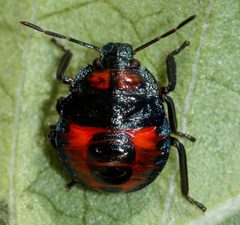
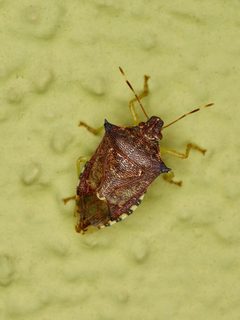
Pronunciation
How to pronounce Podisus sagitta: /ˈpoʊdɪsəs səˈɡɪtə/
These audio files are automatically generated. While they are not always 100% accurate, they are a good starting point.
Images
Distribution
Southern United States to South America, including Central America and the Caribbean. GBIF records confirm presence in the Caribbean, Middle America, North America, and South America.
Ecological Role
; likely functions as a of other insects based on its membership in the predatory Asopinae.
Similar Taxa
- Podisus maculiventrisBoth are predatory stink bugs in the same and (Asopinae). Podisus maculiventris (spined soldier bug) is the most well-studied , used as a agent, and differs in distribution (primarily North America) and specific morphological details.
More Details
Taxonomic note
The was described by Fabricius in 1794. It is less well-studied than the congeneric Podisus maculiventris, which has been extensively researched for applications.
Sources and further reading
- BugGuide
- Wikipedia
- GBIF taxonomy match
- iNaturalist taxon
- A new population of the federally-endangered decurrent false aster | Beetles In The Bush
- Stink Bugs Lay Dark or Light Eggs, Depending on Amount of Light
- Stink Bugs as Biocontrol Agents Against … Stink Bugs
- Bug Eric: New Year’s Insects and Spiders
- Bug Eric: Arrowshaped Micrathena spider
- Plantae | Beetles In The Bush | Page 7
- DESCRIPTION AND LIFE HISTORY OF THE PREDATORY BUG PODISUS SAGITTA (FAB.) (HEMIPTERA: PENTATOMIDAE)