
Pangaeus bilineatus
(Say, 1825)
peanut burrower bug, Two-lined Burrowing Bug
Pangaeus bilineatus, commonly known as the peanut , is a soil-dwelling true in the Cydnidae. It is a major agricultural pest of peanut crops in the southeastern United States, where it causes significant economic damage by feeding underground on developing peanut kernels. The exhibits a single per year in most regions, with entering in soil during winter months. Its subterranean lifestyle renders conventional foliar applications ineffective, necessitating specialized approaches.
Pronunciation
How to pronounce Pangaeus bilineatus: //pænˈdʒiːəs bɪlɪˈneɪtəs//
These audio files are automatically generated. While they are not always 100% accurate, they are a good starting point.
Identification
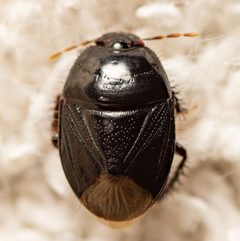
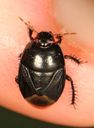
Distinguished from other burrowing bugs by its association with peanut agroecosystems and specific two-lined color pattern (implied by specific epithet "bilineatus"). possess modified forelegs adapted for digging through soil. Newly emerged adults (0-4 hours post-) display orange coloration before full . Last nymphal instar identifiable by presence of wing pads.
Images
Habitat
Sandy soils in agricultural fields, particularly peanut production systems; also occurs in weedy field margins and adjacent uncultivated areas with suitable soil texture. Subterranean environment within soil profile where peanut pods develop. overwinter in soil, undergoing during winter months.
Distribution
Southeastern United States (Florida, Georgia, Alabama, southern Virginia to Texas); Caribbean; Central America; North America broadly; Hawaii. Core economic impact concentrated in peanut-growing regions of the Southeast United States.
Seasonality
overwinter in soil , terminating in early spring when soil temperatures warm. Peak adult abundance during peanut pod development (July-August in most regions). Active nymphs observed during late winter months in Georgia. Single per year in most areas.
Diet
Developing peanut kernels (Arachis hypogaea) using needle-like . Also feeds on other legume crops including soybeans (Glycine max) and cowpeas (Vigna unguiculata), and may feed on seeds of various weeds when cultivated unavailable.
Host Associations
- Arachis hypogaea - primary peanut; major agricultural pest
- Glycine max - secondary soybean
- Vigna unguiculata - secondary cowpea
Life Cycle
Single per year in most regions. Females deposit singly or in small clusters in soil at depths of 1-3 inches near plant roots; egg incubation approximately 1-2 weeks. Nymphs develop through five instars over 4-6 weeks; last instar distinguished by wing pads. Total developmental time from egg to approximately 6-8 weeks depending on temperature. Adults present from late spring through fall.
Behavior
Strong burrowing using modified forelegs to dig through soil. Negative geotaxis leads individuals to move upward in soil profile to locate developing peanut pods. behavior observed around preferred food sources. Capable of long-distance for between fields. and nymphs live primarily in soil, rendering foliar applications ineffective. Nymphs less susceptible than adults to . Conservation tillage practices (strip-tillage, no-till) associated with higher levels; corn-peanut with strip-tilling into corn residues increases F1 adult , possibly due to survival on harvest-loss peanut seeds.
Ecological Role
Agricultural pest causing direct economic damage to peanut production; infested peanuts may be discounted by ≤50% of market price. Feeding wounds on peanut pods create entry points for secondary fungal including Aspergillus flavus, leading to aflatoxin and food safety issues. associated with reduced oxidative stability and increased peroxide levels in peanut kernels. Limited role as seed in non-agricultural .
Human Relevance
Major economic pest of peanut crops in southern United States. Difficult to control due to subterranean feeding habits. Chlorpyrifos historically the only labeled but deregistered, creating urgent need for alternatives. Combined applications of Steinernema carpocapsae ( ) and imidacloprid show synergistic mortality effects at 3-5 days post-inoculation and additive effects at 7-14 days, with no negative impact on nematode . Management strategies include crop , deep tillage to bury , and careful timing of control measures to peak adult activity.
Similar Taxa
- Other Pangaeus speciesSame , different associations and geographic distributions; P. bilineatus specifically associated with peanut agroecosystems
- Other Cydnidae (burrowing bugs)Share adaptations and soil-dwelling habit; distinguished by specific plant associations and two-lined pattern
More Details
Pest Management Challenges
Control is uniquely difficult because the attacks peanut pods underground, rendering foliar applications ineffective. This has driven research into and combined chemical-microbial approaches.
Aflatoxin Connection
Feeding damage creates entry points for Aspergillus flavus, which produces carcinogenic aflatoxins. This secondary can render peanuts unfit for human or animal consumption, amplifying economic losses beyond direct feeding damage.
Sources and further reading
- BugGuide
- Wikipedia
- GBIF taxonomy match
- iNaturalist taxon
- NCBI Taxonomy
- Two new species of Agrilus from Mexico | Beetles In The Bush
- The Peanut Burrower Bug, Pangaeus bilineatus (Say) (Hemiptera: Cydnidae)
- Evaluation of chemical and microbial control options for Pangaeus bilineatus (Say) (Hemiptera: Cydnidae) infesting peanut crop
- Biology and management of the peanut burrower bug (Pangaeus bilineatus) in Southeast United States runner-type peanut