
Pseudopamera setosa
(Stål, 1874)
dirt-colored seed bug
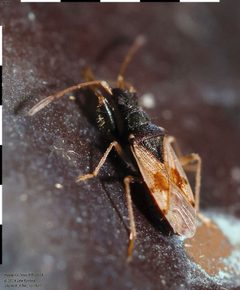
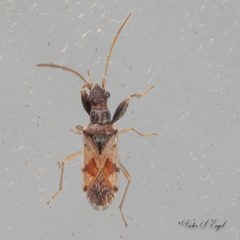
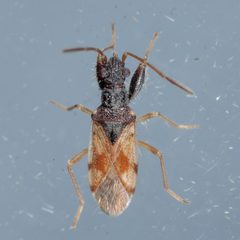
Pseudopamera setosa is a dirt-colored seed bug in the Rhyparochromidae, described by Stål in 1874. The is distributed across North and Central America, with records from the United States, Mexico, Guatemala, and Argentina. Like other members of its family, it belongs to a group of true bugs adapted to seed-feeding habits. The specific epithet 'setosa' refers to the setose (bristly) condition, likely describing a hairy or bristly body surface characteristic of this species.
Pronunciation
How to pronounce Pseudopamera setosa: //ˌsjuːdoʊˈpæmərə sɪˈtoʊsə//
These audio files are automatically generated. While they are not always 100% accurate, they are a good starting point.
Identification
Distinguished from and other Rhyparochromidae by the prominently setose (bristly) body surface, as referenced in the name. Exact diagnostic characters separating it from other Pseudopamera species require examination of male genitalia and detailed setal patterns, which are not summarized in general references. Identification to species level typically requires taxonomic knowledge of the .
Images
Appearance
Body surface covered with conspicuous setae (bristles or hairs), as indicated by the specific epithet 'setosa'. As a member of Rhyparochromidae, possesses the typical dirt-colored seed bug : elongated body form, dull coloration, and with membranous portion. Detailed morphological descriptions beyond setose condition are not readily available in accessible literature.
Habitat
Specific preferences are not documented. Members of Rhyparochromidae generally occur in ground-level vegetation, leaf litter, and low herbaceous plants in terrestrial environments. Likely associated with habitats where seeds are available.
Distribution
Documented from United States, Mexico, Guatemala, and Argentina. Present in North America and Middle America (Central America). The Argentine record may represent a distinct or potential misidentification requiring verification.
Ecological Role
As a , likely functions as a seed in terrestrial . May contribute to seed or plant through seed feeding, though specific ecological impacts are unstudied.
Human Relevance
No documented economic importance. Not known as a pest of agriculture or stored products. Attracted to light in some circumstances based on iNaturalist observations.
Similar Taxa
- Other Pseudopamera speciesShare -level ; distinguished by degree and pattern of setation, plus genitalic characters
- Other Rhyparochromidae genera (e.g., Pamera, Lethaeus)Similar dirt-colored seed bug appearance; separated by antennal segment proportions, body proportions, and male genitalia
More Details
Taxonomic note
The specific epithet 'setosa' (Latin: bristly, hairy) is a descriptive name referring to the setose condition of the body surface, a characteristic feature of this within the .
Nomenclatural history
Originally described by Carl Stål in 1874. The Pseudopamera is placed in tribe Myodochini, a diverse group of seed bugs characterized by various antennal and body proportions.