
Pseudopamera nitidicollis
(Stål, 1874)
dirt-colored seed bug
Pseudopamera nitidicollis is a of in the Rhyparochromidae, first described by Stål in 1874. It is characterized by its dull, earth-toned coloration typical of dirt-colored seed bugs. The species has been documented across Central America and North America, with records from the United States and Mexico. As a member of the Myodochini tribe, it belongs to a group of ground-dwelling seed bugs often associated with soil and litter .
Pronunciation
How to pronounce Pseudopamera nitidicollis: /ˌsuːdoʊˈpæmərə ˌnɪtɪˈdɪkɑːlɪs/
These audio files are automatically generated. While they are not always 100% accurate, they are a good starting point.
Identification
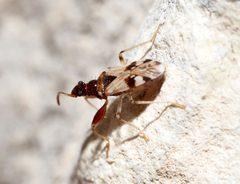
The combination of dull, dirt-colored body with a distinctly shiny or polished pronotum (as indicated by the specific epithet "nitidicollis") serves as a key identifying feature. Within the Pseudopamera, identification typically requires examination of male genitalia and detailed comparison of pronotal and antennal characters. The species can be distinguished from similar dirt-colored seed bugs by its membership in the Myodochini tribe, which generally features more elongated body forms compared to other Rhyparochromidae tribes. Accurate identification to species level requires reference to specialized taxonomic keys for Nearctic Rhyparochromidae.
Images
Appearance
Pseudopamera nitidicollis exhibits the characteristic dull, brownish or grayish coloration typical of dirt-colored seed bugs in the Rhyparochromidae. The name "nitidicollis" refers to the shiny or polished appearance of the pronotum (the plate covering the immediately behind the ). Like other members of Rhyparochromidae, it has an elongated, somewhat flattened body form with long and well-developed legs adapted for ground-dwelling habits. The forewings () show the typical heteropteran structure with a leathery basal portion and membranous portion.
Habitat
Pseudopamera nitidicollis has been observed in diverse terrestrial across its range. Based on the of related Myodochini tribe members, it likely occupies ground-level microhabitats including soil surface, leaf litter, and low vegetation in open woodlands, grasslands, and scrub vegetation. The ' occurrence in both Central American and North American regions suggests adaptability to varied climatic conditions from subtropical to temperate zones.
Distribution
Documented from Central America and North America, with confirmed records from the United States and Mexico. The ' presence spans Middle America and extends into the southern and southwestern United States. Distribution records indicate it is established across multiple ecological regions within this broad geographic range.
Similar Taxa
- Other Pseudopamera speciesCongeneric share similar overall and dull coloration; require genitalia examination for definitive separation
- Myodochini tribe members (e.g., Myodocha, Neopamera)Share elongated body form and ground-dwelling habits; distinguished by pronotal shape, antennal proportions, and genitalic characters
- Other Rhyparochromidae genera (e.g., Rhyparochromus, Stygnocoris)Similar dirt-colored appearance but differ in body proportions, pronotal structure, and wing venation patterns
More Details
Taxonomic authority
The was first described by the Swedish entomologist Carl Stål in 1874, a prominent authority on Hemiptera who described numerous heteropteran species from the Americas.
Etymology
The specific epithet "nitidicollis" derives from Latin "nitidus" (shiny, polished, bright) and "collis" (neck, referring to the pronotum), describing the characteristic appearance of the pronotum in this otherwise dull-colored insect.