
Neopamera bilobata
(Say, 1831)
dirt-colored seed bug
Neopamera bilobata is a in the Rhyparochromidae with a broad distribution across the Americas. It has emerged as a significant pest of strawberry in high tunnel systems, where it causes catfacing damage to fruits. The exhibits distinctive reproductive including male and female resistance during copulation. Laboratory studies indicate a lifespan of approximately 45-52 days and -laying rates of 2.2 eggs per day.
Pronunciation
How to pronounce Neopamera bilobata: /ˌniːoʊˈpæmərə baɪloʊˈbeɪtə/
These audio files are automatically generated. While they are not always 100% accurate, they are a good starting point.
Identification
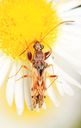
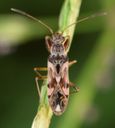
Males possess enlarged forefemora armed with spines, an used in male-male combat. The is a 'dirt-colored seed bug' with typical Rhyparochromidae . Specific diagnostic features distinguishing it from are not documented in available sources.
Images
Habitat
Agricultural: strawberry crops grown in high tunnel systems with suspended wooden structures. Natural requirements are not documented.
Distribution
Widespread across the Americas including USA, Canada, Mexico, Central America ( Rica, Cuba, Dominican Republic, Guatemala, Jamaica, Nicaragua, Panama, Puerto Rico), Caribbean islands (Antigua, Barbados, Bermuda, Grenadines, Guadeloupe, St. Vincent, Vieques, Virgin Islands), and South America (Brazil, Ecuador, French Guiana, Uruguay, Venezuela).
Diet
Feeds on strawberry fruits (Fragaria × ananassa); nymphs and occur on fruits. Natural food sources beyond cultivated strawberry are not documented.
Host Associations
- Fragaria × ananassa - primary (pest damage to fruits)Causes catfacing ; nymphs and feed on fruits
- Allium sativum - companion plant ( reduction) reduces by 35-64% depending on
- Allium tuberosum - companion plant ( reduction)Undercropping reduces by 47%
Life Cycle
to nymph requires 10-12 days. Laboratory-reared individuals: male lifespan 52 days, female lifespan 45 days. Female egg production: 2.2 eggs per day.
Behavior
Male courtship involves vertical body shaking movements. Females resist copulation by pushing males with hind legs. Males engage in physical combat using spined forelegs; enlarged forefemora serve as weapons.
Ecological Role
Agricultural pest in strawberry systems. Susceptible to suppression via with Allium , indicating potential for incorporation.
Human Relevance
Emerging economic pest of strawberry production in protected (high tunnels). with garlic or undercropping with Chinese chives are effective management tools that reduce by 35-64% and 47% respectively.
Sources and further reading
- BugGuide
- Wikipedia
- GBIF taxonomy match
- iNaturalist taxon
- NCBI Taxonomy
- Catalogue of Life
- Copulation, fighting behavior and life cyele of <i>Neopamera bilobata</i> (Heteroptera: Lygaeidae)
- Chinese chives and garlic in intercropping in strawberry high tunnels for Neopamera bilobata Say (Hemiptera: Rhyparochromidae) control