
Neopamera albocincta
(Barber, 1952)
Horn-banded Seed Bug
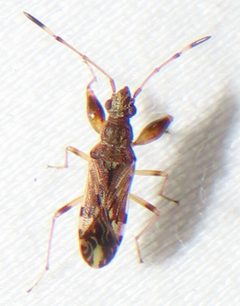
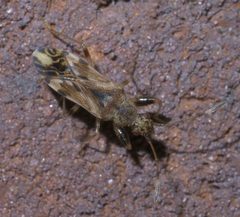
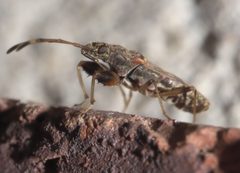
Neopamera albocincta is a in the Rhyparochromidae, commonly known as the Horn-banded Seed Bug. It has a broad distribution spanning the Caribbean, Central America, North America, and South America. The belongs to a diverse group of ground-dwelling seed bugs that feed on fallen seeds. It is relatively well-documented on citizen science platforms with over 1,200 observations.
Pronunciation
How to pronounce Neopamera albocincta: /ˌni.oʊˈpæm.ə.rə ˌæl.boʊˈsɪŋk.tə/
These audio files are automatically generated. While they are not always 100% accurate, they are a good starting point.
Identification
The specific epithet "albocincta" (white-banded) suggests a pale banding pattern, likely on the or body margins, though detailed diagnostic features require literature. As a member of Rhyparochromidae, it possesses the characteristics of elongated body form and seed-feeding mouthparts. Definitive identification to level requires examination of male genitalia or reference to Barber's original 1952 description.
Images
Distribution
Widely distributed across the Caribbean (including Cuba, Jamaica, Hispaniola, Puerto Rico, Trinidad, Tobago, Grenada, Barbados, St. Lucia, St. Vincent, Montserrat, and the Cayman Islands), Central America (Guatemala, Honduras, Panama), North America (southern USA, Mexico), and South America (Brazil, Ecuador, Argentina). Records span both mainland and island localities throughout the Neotropical region.
Similar Taxa
- Other Neopamera speciesThe Neopamera contains multiple with similar ground-dwelling habits and seed-feeding ; accurate separation requires detailed morphological examination.
- Other RhyparochromidaeMany dirt-colored seed bugs share general body form and preferences; -level identification is possible from wing structure and features, but -level identification of N. albocincta requires specific characters.
More Details
Taxonomic history
Originally described by Barber in 1952, placed in Neopamera within tribe Myodochini. The has been recorded in numerous faunistic surveys of Caribbean and Neotropical Rhyparochromidae, notably by Slater (1964) and Baranowski & Slater (2005).
Observation frequency
With over 1,250 observations on iNaturalist, this is among the more frequently documented in its , likely reflecting its broad distribution and relatively distinctive appearance compared to some .