
Myodocha serripes
Olivier, 1811
long-necked seed bug
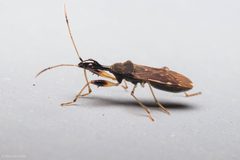
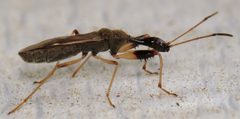
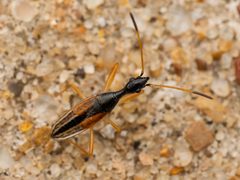
Myodocha serripes, commonly known as the long-necked , is a dirt-colored seed bug in the Rhyparochromidae. It is native to North America, with records from the United States, Canada, and Jamaica. The feeds on seeds and has been documented as a pest on strawberry crops. hibernate during winter, either solitarily or in small groups, before migrating to fields in spring. Activity peaks in autumn, though in Florida remain active year-round without hibernating.
Pronunciation
How to pronounce Myodocha serripes: //maɪˈoʊdəkə ˈsɛrɪˌpiːz//
These audio files are automatically generated. While they are not always 100% accurate, they are a good starting point.
Identification
Distinguished from similar Myodocha by the combination of elongated and pronotum structure and specific antennal and leg characteristics. Separation from Myodocha unispinosa, a related species intercepted at U.S. ports but not established in North America, requires examination of spine patterns on the hind tibiae and other fine morphological details.
Images
Appearance
A dirt-colored seed bug with an elongated body. The "long-necked " refers to the notably elongated and pronotum region, giving the appearance of an extended neck compared to related .
Habitat
Agricultural fields and adjacent areas, particularly those with seed-producing plants. Hibernation occurs in protected locations, with migrating to fields in spring.
Distribution
North America: United States, Canada, and Jamaica. Distribution records include Vermont and broader North American range.
Seasonality
Most active in autumn. hibernate during winter in most of the range, though Florida remain active year-round without entering dormancy.
Diet
Feeds on seeds. Documented as a pest on strawberries.
Host Associations
- strawberry - pesttreated as pests on strawberry crops
Life Cycle
emerge from hibernation in spring and migrate to fields. The completes development through typical hemipteran stages (, nymph, adult), with autumn representing peak adult activity.
Behavior
hibernate alone or in small groups during winter. Spring to fields occurs after from dormancy.
Ecological Role
Seed-feeding insect in agricultural and natural . Acts as a crop pest in strawberry .
Human Relevance
Agricultural pest, specifically documented as damaging to strawberry crops. No other documented economic or medical significance.
Similar Taxa
- Myodocha unispinosaRelated congeneric with similar general appearance; distinguished by hind tibial spine characteristics and not established in North America (intercepted at U.S. ports as a potential )
More Details
Invasive species concern
The related Myodocha unispinosa has been intercepted at U.S. ports of entry (Rio Grande City, 2014) on commercial produce shipments from Mexico, indicating the Myodocha is subject to agricultural scrutiny, though M. serripes itself is native to North America.