
Arocatus melanocephalus
(Fabricius, 1798)
elm seed bug
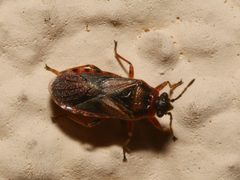
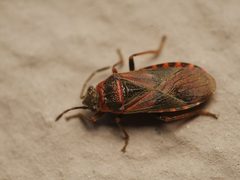
Arocatus melanocephalus, commonly known as the elm , is a true in the Lygaeidae. Native to Europe, it has been introduced to North America in the 2000s and has become a notable nuisance pest in urban areas. The is distinguished by its dark red body, black , and characteristic M-shaped spot on the pronotum. produce a strong, unpleasant odor reminiscent of bitter almonds from metathoracic . Unlike many Lygaeinae species, it has limited ability to store cardenolides.

Pronunciation
How to pronounce Arocatus melanocephalus: //əˈɹoʊkətəs ˌmɛlənoʊˈsɛfələs//
These audio files are automatically generated. While they are not always 100% accurate, they are a good starting point.
Identification
Distinguished from similar Lygaeidae by the combination of black , dark red body with M-shaped pronotal spot, and orange underbelly. The strong bitter almond odor produced by is diagnostic. Unlike many Lygaeinae, it cannot effectively sequester cardenolides. Similar in Arocatus may be separated by color pattern and antennal segmentation details.
Images
Habitat
Associated with elm trees (Ulmus spp.) in urban, suburban, and natural environments. Also recorded on Platanus orientalis (old world sycamore), Populus spp. (poplar), Quercus (oak), and Alnus (alder). In Central Asia, found in city environments with elm tree plantings. frequently enter buildings during summer months, particularly in northern Italian cities and other urban areas.
Distribution
Native to Europe: Andorra, Austria, Belgium, Bosnia & Herzegovina, Bulgaria, Croatia, Czech Republic, France, Germany, Greece, Hungary, Italy, Moldova, Montenegro, Netherlands, Poland, Portugal, Romania, Russia, Serbia, Slovakia, Slovenia, Spain, Switzerland, Ukraine. Asia: Armenia, Azerbaijan, Georgia, Turkey, China (Xinjiang), Iran. Introduced to North America: Canada (British Columbia), United States (Washington, Oregon, Idaho, Michigan, Utah, Colorado).
Seasonality
In Kazakhstan, laid mid-April with appearing mid-June. In Italy, building occur from late May or early June through late September. Activity peaks during summer months. in Central Asia show growth during May and June.
Diet
Feeds on elm tree tissues, including seeds and leaves. Documented to cause 60-95% leaf damage on elm trees in Kazakhstan study. Also observed inside empty pupa covers, though significance of this is unclear.
Host Associations
- Ulmus spp. - primary Elm trees; laid on regenerative organs, significant foliar damage documented
- Platanus orientalis - occasional associationOld world sycamore
- Populus spp. - occasional associationPoplar
- Quercus spp. - recorded presenceOak
- Alnus spp. - recorded presenceAlder
Life Cycle
laid on regenerative organs of elm trees, with oviposition in mid-April in Kazakhstan. Nymphal development occurs through spring, with () appearance in mid-June. and growth occur during May and June in Central Asian populations. Detailed description of nymphal instars not available from sources.
Behavior
produce strong, unpleasant odor reminiscent of bitter almonds from metathoracic (openings between second and third pairs of legs). In urban areas, adults enter buildings during summer heat, particularly in northern Italy (Emilia Romagna, Veneto, Friuli-Venezia Giulia regions) and Germany. Mass occurrences reported in early 21st century in Europe. Some researchers suggest building entry is thermoregulatory to escape heat. in Kazakhstan showed negative correlation with May rainfall; no temperature correlation detected for May-June period.
Ecological Role
Significant foliar pest of elm trees in certain regions; in Almaty region of Kazakhstan, identified as primary agent of elm leaf damage (distinct from other global regions where elm damage is attributed to other causes). Poor cardenolide ability distinguishes it chemically from related Lygaeinae . Role in poorly documented; may serve as prey for .
Human Relevance
Nuisance pest in urban areas due to summer building invasions. Mass occurrences in Italian and German cities since 1999. Chemical control attempted with variable success: etofenprox effective, and ineffective in Turin 2007 trial. Potential pest of ornamental elm plantings. Strong defensive odor may cause indoor annoyance.
Similar Taxa
- Arocatus longicepsClosely related in same clade; both lack ability to store cardenolides; distinguished by morphological details
- Other Arocatus species members share general body plan; A. melanocephalus distinguished by black , M-shaped pronotal spot, and color pattern
- Other LygaeinaeMany related sequester cardenolides effectively; A. melanocephalus distinguished by limited cardenolide storage ability and specific color pattern
More Details
Chemical ecology
Unlike many Lygaeinae , A. melanocephalus stores less than 7% of administered cardenolides ([3H]-ouabain or [3H]-digoxin) ten days post-feeding. This physiological trait places it in a clade with A. longiceps, distinct from other Arocatus species that can sequester cardenolides.
Taxonomic history
Originally described as Lygaeus melanocephalus by Fabricius in 1798. Designated type of Arocatus by Spinola in 1837. Female lectotype designated by Péricart in 1999 at University of Copenhagen Zoological Museum.
Population trends
Thought to have become rarer in Central Europe in late 20th century due to reducing tree abundance. Resurgence and mass occurrences in early 21st century in Italy and Germany, possibly linked to global warming and urban heat island effects.