
Arocatus
Spinola, 1837
Species Guides
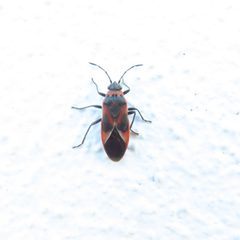
1- Arocatus melanocephalus(elm seed bug)
Arocatus is a of true bugs in the Lygaeidae, Lygaeinae. The genus contains approximately 20 described distributed across Europe, Asia, and associated islands. The most studied species, Arocatus melanocephalus (elm ), has been documented as a pest of elm trees in Kazakhstan. Taxonomic revisions have clarified species boundaries and resolved confusion with related genera Caenocoris and Thunbergia.
Pronunciation
How to pronounce Arocatus: /ˌæroʊˈkeɪtəs/
These audio files are automatically generated. While they are not always 100% accurate, they are a good starting point.
Identification
Arocatus can be distinguished from the related Caenocoris by subtle differences in coloration and body proportions. The genus Thunbergia, which has been confused with Arocatus, can be separated by diagnostic characters of the external male genitalia; Arocatus lacks the specific genitalic structures present in Thunbergia. Intraspecific variability in A. pseudosericans has been documented and complicates field identification.
Images
Habitat
of Arocatus have been recorded in association with elm trees (Ulmus spp.), particularly in urban and suburban environments. In the Almaty region of Kazakhstan, A. melanocephalus inhabits areas with planted elm trees.
Distribution
The occurs in Europe, Asia, Taiwan, the Ryukyu Archipelago (Japan), Japan, and Korea. Specific distribution records include: Kazakhstan (Almaty region), Taiwan, and broader Palearctic regions. GBIF distribution codes indicate presence in Northern Europe (NO) and Southern Europe (SE).
Seasonality
Arocatus melanocephalus exhibits in mid-June in the Almaty region, following deposition in mid-April. growth occurs during May and June.
Host Associations
- elm trees (Ulmus spp.) - Arocatus melanocephalus lays on regenerative organs; causes significant leaf damage (60%-95% in Kazakhstan study)
Life Cycle
Arocatus melanocephalus: laid mid-April; () appearance mid-June. Complete developmental stages not documented in available sources.
Ecological Role
Arocatus melanocephalus functions as a foliar pest of elm trees in the Almaty region of Kazakhstan, where it has been identified as the primary cause of elm tree leaf damage. This ecological role appears regionally distinct, as the does not typically cause significant leaf damage in other parts of its range.
Human Relevance
Arocatus melanocephalus is recognized as an urban tree pest in Kazakhstan, where it causes substantial aesthetic and potential economic damage to ornamental elm plantings. The has been targeted for phenological study to inform control strategies.
Similar Taxa
- CaenocorisHistorical confusion in identification; earlier records of Caenocoris dimidiatus from Taiwan and the Ryukyu Archipelago were reassigned to Arocatus elegantulus
- ThunbergiaIdentification problems historically; can be distinguished by external male genitalia characters, with Thunbergia possessing diagnostic structures absent in Arocatus
More Details
Taxonomic complexity
The has undergone significant taxonomic revision, particularly in East Asia. The description of A. elegantulus from Taiwan resolved long-standing confusion with Caenocoris dimidiatus. Records of A. sericans from Taiwan were determined to represent A. pseudosericans, highlighting the need for careful examination of specimens in this group.
Regional variation in pest status
Arocatus melanocephalus exhibits markedly different ecological impacts across its range. While causing severe leaf damage (60%-95%) in Kazakhstan, it is not reported as a significant pest in other regions, suggesting possible regional plant differences, environmental factors, or genetic variation.