
Ischnorhynchinae
Stål, 1872
Genus Guides
1- Kleidocerys(seed bugs)
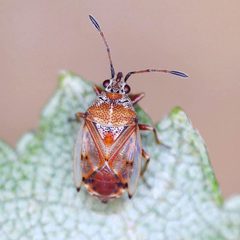
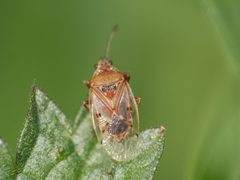
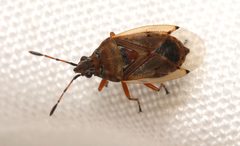
Ischnorhynchinae is a of seed bugs in the Lygaeidae, comprising approximately 16 and more than 70 described . Members are small, terrestrial insects characterized by translucent or transparent plate-like structures covering the (pronota). The subfamily has been subject to taxonomic debate, with some authors treating it as a separate family (Ischnorhynchidae), though current consensus places it within Lygaeidae.
Pronunciation
How to pronounce Ischnorhynchinae: /ˌɪsknoʊraɪnˈkaɪni/
These audio files are automatically generated. While they are not always 100% accurate, they are a good starting point.
Identification
Distinguished from other Lygaeidae by the presence of translucent or transparent plate-like pronotal structures. Male genitalia are diagnostic at the level, with a trifurcate featuring two lateral membranous lobes and a ; the endosoma bears two lateral sclerotized struts.
Images
Habitat
Associated with plant flowers; at least some are associated with specific plants, including cypress trees (Hesperocyparis spp., Cupressaceae).
Distribution
Widespread distribution with records from Australia (Queensland, New South Wales, Australian Capital Territory, Victoria, South Australia, Tasmania), Indonesia (Sulawesi, Sumatra), Malaysia (Sarawak, Peninsular Malaysia), and China (Jiangsu Province, Chongqing).
Host Associations
- Hesperocyparis spp. - seed Kleidocerys obovatus feeds on cypress seeds
Similar Taxa
- LygaeinaeBoth are of Lygaeidae; Lygaeinae lack the translucent pronotal plate-like structures characteristic of Ischnorhynchinae
- OrsillinaeThird recognized of Lygaeidae; distinguished by genitalic and pronotal
More Details
Taxonomic History
The taxonomic status of Ischnorhynchinae has been debated, with some authors treating it as a separate (Ischnorhynchidae). Current consensus based on molecular phylogenetic analyses supports its placement as a of Lygaeidae.
Molecular Data
Complete mitochondrial have been sequenced for Pylorgus porrectus (15,174 ) and Pylorgus sordidus (15,399 bp), the first such data for the . These genomes exhibit typical insect mitochondrial structure with 13 protein-coding genes, 22 tRNAs, 2 rRNAs, and a control region.
Largest Genus
Pylorgus is the largest in Ischnorhynchinae, with at least two (P. porrectus and P. sordidus) characterized by mitochondrial sequencing.
Sources and further reading
- BugGuide
- Wikipedia
- GBIF taxonomy match
- iNaturalist taxon
- NCBI Taxonomy
- Catalogue of Life
- THE DISTRIBUTION, MALE GENITALIA AND MORPHOLOGICAL VARIATION OF ACANTHOCROMPUS GRANDIS SCUDDER (HEMIPTERA: LYGAEIDAE: ISCHNORHYNCHINAE)
- Kleidocerys obovatus Van Duzee (Hemiptera: Lygaeidae: Ischnorhynchinae): New Distribution Records and Habits of an Apparent Seed Specialist on Cypress, Hesperocyparis spp. (Cupressaceae)
- Characterization of two new Pylorgus mitogenomes (Hemiptera, Lygaeidae, Ischnorhynchinae) and a mitochondrial phylogeny of Lygaeoidea.