
Mezira
Amyot & Serville, 1843
flat bugs
Species Guides
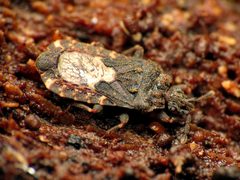
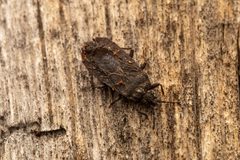
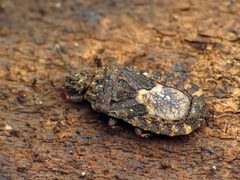
9Mezira is a of flat bugs in the Aradidae containing over 70 described . Members are characterized by dorsoventrally flattened bodies adapted for living in confined spaces under bark and in leaf litter. The genus exhibits specialized morphological adaptations for mycetophagy, including elongated stylets and modified mouthpart for feeding on fungal mycelia and fruiting bodies.
Pronunciation
How to pronounce Mezira: //mɛˈzɪɹə//
These audio files are automatically generated. While they are not always 100% accurate, they are a good starting point.
Identification
Distinguished from other aradid by combination of: distally constricted labial tip with reduced (only three pairs of sensilla basiconica III versus more numerous sensilla in related ); mandibular apex with uniform ridge-like teeth rather than pointed or irregular ; and extremely elongated stylets matching body length. Antennal sensilla cluster at second flagellar segment apex may aid -level identification.
Images
Appearance
Dorsoventrally flattened body typical of Aradidae. with five types of : three subtypes of sensilla trichodea, three subtypes of sensilla basiconica, two subtypes of sensilla chaetica, sensilla campaniformia, and sensilla styloconica. Apex of second flagellar segment bears dense sensilla cluster. distally constricted at tip (rare in Pentatomomorpha), with three subtypes of sensilla trichodea, three subtypes of sensilla basiconica, and sensilla campaniformia. Labial tip with only three pairs of sensilla basiconica III and small comb-shaped cuticular processes. Mandibular apex with 8–10 ridge-like central teeth. Stylets extremely elongated, equivalent to body length.
Habitat
Under bark of dead trees and in leaf litter; mesic environments with decaying wood and fungal growth. Laboratory rearing successful at 26±0.5°C and 70±10% relative humidity.
Distribution
Southern China (documented from Guizhou Province); additional records from Norway and Sweden (GBIF). Distribution likely broader across suitable forest in Asia and potentially Palearctic region.
Diet
Mycetophagous: feeds on fungal mycelia and fruiting bodies. Laboratory observations document feeding on cultivated mushrooms Pleurotus ostreatus and P. citrinopileatus.
Host Associations
- Pleurotus ostreatus - food sourcelaboratory feeding confirmed
- Pleurotus citrinopileatus - food sourcelaboratory feeding confirmed
Behavior
Fungal feeding involves using elongated stylets to penetrate fungal tissue. Antennal cluster at second flagellar segment apex functions in chemical and mechanical signal reception during location. Labial tip sensilla basiconica III form sensilla cluster for evaluating food quality.
Ecological Role
Decomposer in forest , processing fungal associated with dead wood and leaf litter. Some may function as agricultural pests in mushroom .
Human Relevance
Potential pest in oyster mushroom (Pleurotus) operations. Subject of morphological studies on mycetophagy in true bugs.
Similar Taxa
- Other Aradidae generaMezira distinguished by distally constricted labial tip with reduced count and ridge-like mandibular teeth; most other aradids have more numerous labial sensilla and pointed mandibular
- Other PentatomomorphaLabial tip constriction rare in this infraorder; Mezira exhibits unique three-pair basiconica III arrangement versus more complex labial tip structures in related
More Details
Morphological specializations for mycetophagy
Scanning electron microscopy reveals convergent adaptations for fungal feeding: elongated stylets for tissue penetration, reduced labial count suggesting simplified evaluation of uniform fungal substrate, and antennal sensilla clusters for detecting fungal chemical cues. These structures facilitate comparative study of adaptive evolution in Pentatomomorpha.
Taxonomic scope
contains over 70 described ; morphological data in primary sources derived from M. yunnana. Species-level variation in feeding and distribution remains poorly documented.