
Aradus curticollis
Bergroth, 1913
Aradus curticollis is a of flat bug in the Aradidae, described by Bergroth in 1913. Like other members of the Aradus, it belongs to a group of true bugs commonly associated with dead wood . The species is recorded from North America, though specific details about its and remain poorly documented in available literature.
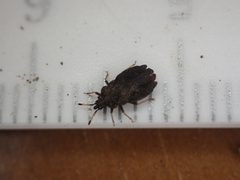
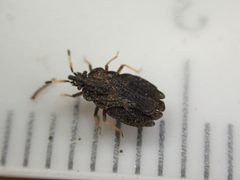
Pronunciation
How to pronounce Aradus curticollis: /ˈa.ra.dus ˌkɜː.tɪˈkɒ.lɪs/
These audio files are automatically generated. While they are not always 100% accurate, they are a good starting point.
Images
Habitat
Aradidae members are commonly found on and under the bark of dead trees. Based on this family-level association, A. curticollis likely inhabits dead wood environments, though direct records for this specific are not documented in the provided sources.
Distribution
North America. Distribution records indicate presence in this region, though precise range boundaries are not specified in available sources.
Similar Taxa
- Aradus macrosomusBoth are members of the Aradus. A. macrosomus is a fossil from Eocene Baltic amber (~45 million years old), distinguished by its unusually large body size compared to other Aradus species. A. curticollis is an extant species with no size-related etymology.
- Other Aradus speciesThe Aradus contains multiple that share the flattened body form and dead wood associations typical of flat bugs. Specific distinguishing characters for A. curticollis are not documented in available sources.
More Details
Taxonomic note
The epithet 'curticollis' suggests 'short-necked' (from Latin 'curtus' = short + 'collum' = neck), though the specific morphological feature this refers to is not detailed in available sources. This distinguishes it from A. macrosomus, whose name refers to large body size.
Data limitations
Available sources provide minimal information specific to A. curticollis beyond its taxonomic classification and broad geographic distribution. Most detailed biological information in the provided context refers to the fossil A. macrosomus or general characteristics of the Aradidae.