
Aquarius remigis
(Say, 1832)
common water strider
Aquarius remigis is a predatory aquatic known as the common . Formerly classified as Gerris remigis, the was reclassified in 1990 when Aquarius was elevated to generic rank. It inhabits freshwater surfaces across North America, with highest in the midwestern United States. exhibit geographic variation in , with northern populations typically and southern populations showing greater plasticity in voltinism.
Pronunciation
How to pronounce Aquarius remigis: /əˈkwɛəriəs ˈrɛmɪdʒɪs/
These audio files are automatically generated. While they are not always 100% accurate, they are a good starting point.
Identification
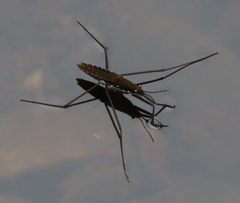
Distinguished from other water striders by combination of large body size (exceeding 12 mm), dark brown to black coloration, and geographic distribution. Formerly confused with Gerris before taxonomic revision elevated Aquarius to . Identification to species level may require examination of genitalic structures or geographic context.
Images
Habitat
Freshwater surface including streams, ponds, and other standing or flowing water bodies. Occupies the water surface film where it forages and locomotes. in higher altitude streams experience lower water surface temperatures and food abundance compared to lowland populations.
Distribution
North America, with records throughout the continent; most prevalent in the midwestern United States. Extends into Middle America. studied from Quebec (ca. 46°N), New York (ca. 43°N), New Jersey (ca. 41°N), and Kentucky demonstrate latitudinal variation in .
Seasonality
Activity period varies by latitude and strategy. Northern (Quebec) typically with reproducing the following spring. Southern populations may exhibit cycles with direct under favorable conditions. Mating activity decreases as season progresses in summer- individuals.
Diet
Predatory feeding on mosquito larvae beneath the water surface, dead insects floating on the surface, and other insects that accidentally land on water.
Life Cycle
varies geographically. Northern typically : individuals reach adulthood in summer, enter , and reproduce the following spring. Southern populations may be , with some individuals reproducing directly after maturation. and food availability influence reproductive expression. laid on plant stems at water's edge.
Behavior
Uses middle and hind legs to row quickly across water surface. Employs front legs to seize prey. Communicates with potential mates via ripple signals sent across water surface during breeding season. Non-reproductive individuals often territorial; reproductive individuals more mobile, with males showing higher mobility than females. Males produce high-frequency ripple signals during non-mating season agonistic encounters that increase dominance. Post-copulatory mate guarding occurs, with males carrying females on their backs, imposing locomotor costs on females.
Ecological Role
Surface-dwelling and scavenger in freshwater . Controls of mosquito larvae and other aquatic or surface insects.
Human Relevance
agent for mosquito larvae. Subject of extensive behavioral and evolutionary research due to observable surface-dwelling habits and complex mating systems.
Similar Taxa
- Gerris speciesFormerly classified within same ; distinguished by taxonomic revision elevating Aquarius based on phylogenetic analysis
- Other Aquarius speciesSame ; may require examination of genitalic structures or geographic range for definitive identification
More Details
Reproductive Tactic Plasticity
show clinal variation in reproductive tactic expression. Northern populations (Quebec) show canalized delayed with . Transition zone populations in New York show plastic expression of direct versus delayed reproduction based on and food abundance cues. Higher altitude populations within transition zones show greater canalization than lowland populations, likely due to shorter seasons and lower temperatures.
Mating System
Prolonged copulation occurs, with insemination happening at copulation end rather than serving as post-insemination mate guarding. Sperm transferred as coherent coiled mass, moving rapidly to spermathecal tube. Some sperm move directly to fecundation canal enabling immediate . Prolonged copulation associated with increased spermathecal tube filling, suggesting copulatory courtship or sperm loading function.
Genetic Architecture
positively associated with differences between sexes in proportions of autosomal dominance variance. Strong interactions among additive, sex-linked, and dominance genetic components indicate their relative influence differs among traits and between sexes.
Sources and further reading
- BugGuide
- Wikipedia
- GBIF taxonomy match
- iNaturalist taxon
- NCBI Taxonomy
- Catalogue of Life
- Life History Dependent Behavioural Variation in Water Striders, Aquarius remigis
- Costs of loading associated with mate-carrying in the waterstrider, Aquarius remigis
- Altitudinal differentiation of reproductive tactic plasticity despite the close proximity of two Aquarius remigis populations
- Life history adaptation along a latitudinal cline in the water strider Aquarius remigis (Heteroptera: Gerridae)
- Effect of sperm depletion and starvation on female mating behavior in the water strider, Aquarius remigis
- Prolonged copulation and the internal dynamics of sperm transfer in the water strider Aquarius remigis
- Experiments on the effects of food and density on voltinism in a stream‐dwelling water strider (Aquarius remigis)
- Tests for associations between sexual dimorphism and patterns of quantitative genetic variation in the water strider, Aquarius remigis
- Signalling Asymmetry in the Communication of the Water Strider Aquarius remigis in the Context of Dominance and Spacing in the Non‐mating Season
- Plasticity of Mating Duration in Response to Slightly Biased Operational Sex Ratios in the Water Strider (Aquarius remigis): The Effect of Cohabitation Under Standard Laboratory Conditions