
Emesaya brevipennis
(Say, 1832)
thread-legged bug
Emesaya brevipennis is a thread-legged assassin bug in the Emesinae, distributed across the New World from North America through Central America to South America. The comprises three , all occurring in North America north of Mexico. The nominate subspecies E. b. brevipennis is the most widely distributed and has been documented as in southern Illinois, with five instars. This species exhibits specialized predatory , including kleptoparasitism of spider prey and intraguild on conspecifics.
Pronunciation
How to pronounce Emesaya brevipennis: /ˈɛmɛˌsaɪə ˌbrɛvɪˈpɛnɪs/
These audio files are automatically generated. While they are not always 100% accurate, they are a good starting point.
Identification
Members of the Emesaya can be distinguished from other Emesinae by genitalic and wing venation characters, though specific diagnostic features for E. brevipennis require examination of taxonomic keys. The E. b. brevipennis is distinguished from other subspecies by distribution and subtle morphological differences. Accurate identification to level typically requires examination of male genitalia and comparison with type material.
Images
Appearance
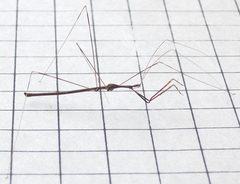
Thread-legged bugs in the Emesinae are characterized by extremely slender, elongate bodies and disproportionately long, thin legs adapted for capturing prey in confined spaces. Members of this subfamily typically possess forelegs modified for grasping prey. Specific morphological features distinguishing E. brevipennis from are not documented in available sources.
Habitat
Occurs in diverse across its broad New World range. In southern Illinois, the has been successfully reared in laboratory conditions, suggesting adaptability to temperate environments. Specific microhabitat preferences such as vegetation type or structural features are not documented in available sources.
Distribution
New World distribution spanning North America, Central America, and South America. Three occur in North America north of Mexico. The nominate subspecies E. b. brevipennis is the most widely distributed. GBIF records indicate presence in Brazil (Mato Grosso) and throughout Middle America.
Seasonality
The E. b. brevipennis is reported to be in southern Illinois, indicating two per year with activity during multiple seasons. Specific timing of adult and peak activity periods are not documented in available sources.
Diet
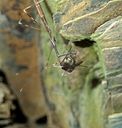
Predatory. Documented prey includes spiders, which are attacked directly and also robbed of captured prey. The has been observed to practice intraguild , feeding upon conspecifics in both larval (nymphal) and stages. Specific non-spider prey items are not documented in available sources.
Life Cycle
The E. b. brevipennis has five instars (nymphal stages) before reaching adulthood. Laboratory rearing has been successfully accomplished, enabling detailed observation of development. The is in southern Illinois, completing two annually. Duration of instars, stage, and other details require access to full primary literature.
Behavior
. Exhibits kleptoparasitic , robbing spiders of their captured prey. Practices intraguild () on nymphs and . These behaviors suggest an opportunistic predatory strategy that includes both direct hunting and theft of secured food resources.
Ecological Role
in , with documented interactions in spider as both competitor (via kleptoparasitism) and predator. Intraguild on conspecifics may function in . Specific impacts on prey or broader function are not quantified in available sources.
Human Relevance
No documented direct impacts on human activities, agriculture, or health. The has been utilized in laboratory studies of reduviid and rearing methodology, contributing to basic scientific knowledge of assassin bug .
Similar Taxa
- Other Emesaya species share the thread-legged and Emesinae characteristics; accurate separation requires examination of male genitalia and detailed morphological analysis
- Other Emesinae genera (e.g., Emesopsis, Ploiaria)Similar extremely slender body plan and forelegs; distinguished by wing venation, tarsal structure, and genitalic characters
More Details
Subspecies
Three recognized, all restricted to North America north of Mexico: E. b. brevipennis (nominate, most widely distributed), plus two additional subspecies not named in available sources.
Laboratory Rearing
Successful laboratory rearing protocols have been established for E. b. brevipennis, facilitating detailed study. This represents one of the few Emesinae with documented captive breeding methodology.
Sources and further reading
- BugGuide
- Wikipedia
- GBIF taxonomy match
- iNaturalist taxon
- NCBI Taxonomy
- Catalogue of Life
- Bembicid Holdings | Entomology Research Museum
- Minstrels of the meadow: Short-winged meadow katydid, Conocephalus brevipennis — Bug of the Week
- Disteniidae | Beetles In The Bush
- Archive — Bug of the Week
- insects | Beetles In The Bush | Page 10
- Life History and Laboratory Rearing of Emesaya b. brevipennis (Heteroptera: Reduviidae) in Southern Illinois