
Leistarchini
Stål, 1862
thread-legged bugs
Genus Guides
1- Ploiaria(thread-legged bugs)
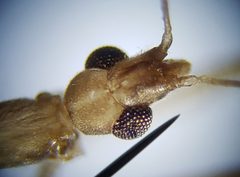
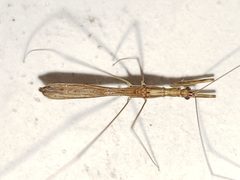
Leistarchini is a tribe of thread-legged bugs within the Emesinae ( Reduviidae). Members of this group are characterized by their elongated, slender bodies and extremely long, thin legs—adaptations for living in narrow spaces such as spider webs and crevices. The tribe was established by Carl Stål in 1862. These predatory true bugs are part of the diverse assassin bug fauna, though specific biological details for many constituent remain poorly documented.
Pronunciation
How to pronounce Leistarchini: //ˌlaɪstɑːrˈkaɪnaɪ//
These audio files are automatically generated. While they are not always 100% accurate, they are a good starting point.
Identification
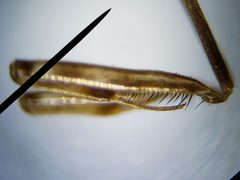
Distinguished from other Emesinae tribes by combinations of antennal segment proportions, forewing venation patterns, and male genitalia structure. Leistarchini typically have the first antennal segment shorter than the , and the forewing with reduced or simplified venation compared to Ploiariolini or Metapterini. The pronotum is usually constricted at the base. Accurate identification to tribe level requires examination of wing venation and genitalic characters; superficial similarity to other thread-legged bugs necessitates microscopic or dissection-based confirmation.
Images
Appearance
Members of Leistarchini display the characteristic thread-legged bug : extremely slender, elongate body with a cylindrical or slightly flattened profile. Legs are disproportionately long and thin, particularly the middle and hind pairs, giving a spider-like appearance. are long and multi-segmented. The is usually narrow with a curved, three-segmented rostrum (beak) folded beneath. Coloration is typically cryptic—shades of brown, tan, or gray—with reduced wing venation in many . Body length ranges from approximately 5–15 mm depending on .
Habitat
Associated with sheltered microhabitats: rock crevices, caves, hollow plant stems, under bark, and notably within spider webs where some are kleptoparasitic or predatory on the web occupant. Many species inhabit arid or semi-arid regions. Specific moisture and substrate requirements vary by and are not well characterized for the tribe as a whole.
Distribution
Widely distributed across tropical and subtropical regions, with records from Africa, Asia, Australia, and the Americas. The tribe shows highest diversity in the Old World tropics. Precise distributional boundaries are obscured by taxonomic uncertainty and under-collection in many regions.
Behavior
Some have been observed living within spider webs, where they may steal prey (kleptoparasitism) or attack the spider itself. The long legs are adapted for moving on silk threads without triggering the spider's vibration-based predatory responses. General behavioral patterns for the tribe are inferred from limited observations of select .
Ecological Role
Predatory components of in cryptic ; some function as specialized or kleptoparasites of web-building spiders. Their role in nutrient cycling and dynamics in cave and crevice is likely significant but unquantified.
Human Relevance
No direct economic importance. Occasionally encountered in cave of interest to speleologists. Some may be collected as part of general biodiversity surveys in threatened .
Similar Taxa
- MetapteriniAnother tribe of Emesinae with thread-legged ; distinguished by differences in forewing venation and antennal proportions, particularly the relative length of the first antennal segment
- PloiarioliniShares elongated body form; Leistarchini typically have more reduced wing venation and different antennal segment ratios
- EmesiniTribe within same ; generally more robust body form and different leg proportions
More Details
Taxonomic History
The tribal classification of Emesinae has undergone significant revision. Leistarchini was established by Stål in 1862 but boundaries and constituent have been modified by subsequent including Wygodzinsky (1966) and others. Modern molecular may further revise tribal limits.