
Prepops cruciferus
(Berg, 1878)
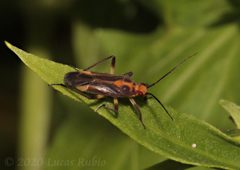
Prepops cruciferus is a plant bug in the Miridae native to the Neotropics. It was first described from Argentina in 1878 and has been documented across South America, Central America, and the Caribbean. The was newly discovered in the United States (Florida) in the late 20th century, representing a northward range expansion. It is associated with vegetation and has documented plant relationships.
Pronunciation
How to pronounce Prepops cruciferus: //ˈprɛpɒps kruːˈsɪfərəs//
These audio files are automatically generated. While they are not always 100% accurate, they are a good starting point.
Images
Habitat
Vegetation in tropical and subtropical environments. Associated with plants in natural and disturbed .
Distribution
Native to the Neotropical region: Argentina (Buenos Aires and other provinces), Brazil (widespread including Amazonas, Bahia, Goiás, Minas Gerais, Mato Grosso, Pará, Rio de Janeiro, Rio Grande do Sul, Santa Catarina, São Paulo), Colombia, Ecuador, Paraguay, Peru, Suriname, Panama, Cuba, Grenada, and other Caribbean islands. Established in the United States: Florida.
Diet
Phytophagous; feeds on plant sap.
Human Relevance
Documented as a non-native in Florida with potential significance for monitoring range expansions of Neotropical insects into the United States.
More Details
Host Plants
plant associations have been documented in the primary taxonomic literature, though specific host plant names are not extractable from available abstract-level sources. Full text of the 1990 Annals of the Entomological Society of America paper contains detailed host records.
Taxonomic History
Originally described by Berg in 1878. The 1990 paper by Henry and Wheeler provided the first comprehensive treatment of this in the United States context, including taxonomic notes to distinguish it from related species.