
Rhabdomiris striatellus
(Fabricius, 1794)
Striped Oak Bug
Rhabdomiris striatellus is a mirid bug distributed across the Palearctic region, from Europe through Asia Minor to the Caucasus. The is strongly associated with oak trees (Quercus spp.). measure 7–9 mm and display variable coloration from yellow to reddish-brown with distinctive wing patterning. The species exhibits life stage-dependent feeding habits: nymphs feed on plant material while adults are predatory.
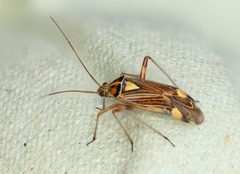
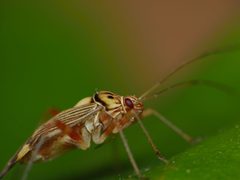
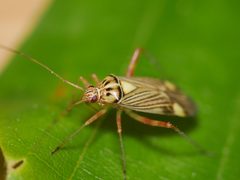
Pronunciation
How to pronounce Rhabdomiris striatellus: /ræb.doʊˈmaɪ.rɪs striː.əˈtɛl.əs/
These audio files are automatically generated. While they are not always 100% accurate, they are a good starting point.
Identification
Distinguished from the related Miris striatus by generally smaller size and more consistent striping pattern, though dark morphs can appear similar. The combination of oak association, yellow wing , and dark longitudinal stripes is diagnostic. Examination of male genitalia may be required for definitive separation from similar dark forms of related .
Images
Appearance
Body length 7–9 mm. Coloration ranges from yellow to reddish-brown, with yellow wing and dark longitudinal stripes on the wings. Darker morphs occur, sometimes appearing nearly black. The body is elongate and slender, typical of the .
Habitat
Strongly associated with oak trees (Quercus spp.), including both deciduous and evergreen . Found in woodland, parkland, and hedgerows where oaks occur. Occupies and shrub layer of oak-dominated .
Distribution
Widespread across the Palearctic ecozone. In Europe, present from the British Isles and Scandinavia (except extreme north) south to the Mediterranean basin (excluding southernmost regions). Range extends east through Asia Minor to the Caucasus. Common and widespread in the United Kingdom.
Diet
Life stage-dependent: nymphs feed on flowers and fruits; are predatory, consuming aphids and larvae of other insects.
Host Associations
- Quercus spp. - and probable plantStrongly associated with oak trees for all life stages
Life Cycle
Develops through and nymphal stages to . Nymphs feed on plant material (flowers, fruits) before transitioning to predatory as adults.
Ecological Role
Similar Taxa
- Miris striatusClosely related with similar dark coloration in some morphs; R. striatellus distinguished by smaller size, more consistent wing striping, and association with oak
More Details
Color Polymorphism
The exhibits notable color variation, with some individuals appearing much darker. This variability has historically contributed to confusion with related species.
Feeding Strategy Shift
The transition from in nymphs to in represents an unusual ontogenetic dietary shift within Miridae.