
Derbidae
Spinola, 1839
Derbid Planthoppers, Derbids
Subfamily Guides
3is a large and diverse of planthoppers within the superfamily Fulgoroidea, comprising over 1,700 described in 166 . are small sap-sucking insects typically 5–10 mm in length, with highly variable across and tribes. The family exhibits striking diversity in wing shape, structure, and form. Nymphs develop in decaying organic matter, particularly under bark of dead trees and in palm debris, where they feed on fungi—an unusual trait among planthoppers. Several species are economically significant as suspected of phytoplasma affecting palms, including lethal yellowing and related , though clear evidence of transmission remains limited.

Pronunciation
How to pronounce Derbidae: //ˈdɜː.bɪˌdiː//
These audio files are automatically generated. While they are not always 100% accurate, they are a good starting point.
Identification
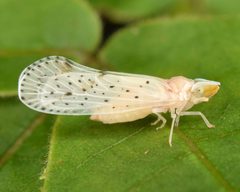
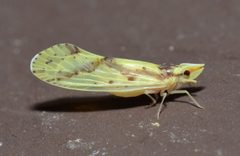
Derbids are distinguished from other planthopper primarily by the very short terminal segment of the rostrum, which is often only as long as it is wide. Body length from to forewing tip ranges 5–10 mm, with the typically comprising slightly more than half this length. In the common form (e.g., tribe Cenchreini), wings are held in a roof-like (tectiform) position at rest, with uniformly rounded wing tips and head profile; are small and inconspicuous. However, considerable morphological variation exists: some groups have extremely long, narrow forewings with reduced hindwings (tribe Zoraidini), wings held spread flat at rest, heads extended into thin leaf-like blades, or long branched antennae. Coloration and wing patterns vary widely, with some exhibiting striking markings.
Images
Habitat
occur on living plants, particularly monocots such as palms, where they feed on sap. Nymphs inhabit decaying organic matter, specifically under bark of dead tree trunks, in heaps of palm debris, and in decomposing plant material. In at least one documented case, nymphs have been found in moss mats. The association with fungal decomposition in rotting substrates is a consistent microhabitat requirement for stages.
Distribution
Widely distributed across tropical, subtropical, and temperate regions worldwide. Particularly diverse and abundant in the humid tropics of southern Asia, Australia, the Pacific islands, West Africa, and the Neotropics. Specific documented locations include Borneo, New Guinea, surrounding islands, Laos, Vietnam, Taiwan, West Malaysia, Solomon Islands, Vanuatu, Tonga, New Caledonia, India, Sri Lanka, Sulawesi, Sumatra, Philippines, South China, Thailand, Fiji, Java, Nigeria, Ivory Coast, Rica, Jamaica, Amazonas (Brazil), and the southern United States.
Diet
feed on plant sap, with documented preference for monocots especially palms (Arecaceae). Specific feeding locations include the side of leaflets, with preference for basal leaflets of fronds and areas near the midrib. Nymphs feed on fungi associated with decaying organic matter; the fungus Neurospora growing on oil palm bunch waste has been specifically implicated in attracting oviposition. One has been observed feeding on moss or associated fungi.
Life Cycle
Nymphal stages develop in decaying organic matter rather than on living plants. emerge and move to living vegetation for feeding and . The rotting smell and coloration of fungi in decomposing substrates attracts females for oviposition.
Behavior
are often described as "gathering" or "resting" on plants. They are typically found in feeding position on the surface of leaves. Short-distance is typical. Adults show directional preference for certain frond orientations, with outer fronds directed north-south attracting more individuals than east-west oriented fronds. Feeding punctures are not visible to the naked and do not produce hopper burn or feeding marks. Early-stage diseased palms attract significantly more adults than healthy palms.
Ecological Role
function as phloem feeders on living plants, particularly palms. Nymphs contribute to nutrient cycling through their association with fungal decomposition in rotting wood and plant debris. Several are suspected of phytoplasma causing lethal yellowing in palms, potentially playing a role in disease , though definitive transmission evidence remains incomplete.
Human Relevance
Several are economically important as pests and suspected of palms. Proutista moesta transmits root (wilt) disease of coconut, yellow leaf disease of arecanut, and spear rot disease of oil palm in India. Diostrombus mkurangai and related species are associated with lethal yellowing disease of coconut in Mozambique and Ghana. Cedusa species have been implicated in coconut lethal yellowing in Jamaica. Omolicna joi is associated with Texas Phoenix Palm Decline in Florida. Oil palm agro- provide abundant breeding substrates, potentially exacerbating pest pressure.
Similar Taxa
- AchilidaeSister most morphologically similar to ; some (e.g., Breddiniola) have been transferred between families based on revised interpretation of characters. Both families share features of wing venation and body form, requiring careful examination of rostrum structure for definitive separation.
- CixiidaeAnother fulgoroid containing palm-associated planthoppers; Haplaxius crudus is the only confirmed of lethal yellowing phytoplasma. Cixiids differ in nymphal (typically root-feeders rather than saprophytic) and rostrum structure. Both families have been implicated as potential phytoplasma vectors, requiring molecular confirmation for specific associations.
- Tropiduchidae analyses indicate close phylogenetic relationship with . Morphologically distinct in wing structure and shape; lacks the abbreviated terminal rostrum segment diagnostic of Derbidae.
Sources and further reading
- BugGuide
- Wikipedia
- GBIF taxonomy match
- iNaturalist taxon
- NCBI Taxonomy
- Catalogue of Life
- Revision of the planthopper tribe Rhotanini (Hemiptera: Auchenorrhyncha: Derbidae)
- Cixiidae and Derbidae (Hemiptera) Putative Vectors of Phytoplasma of Group 16 Sriv
- Notes on some Oriental Derbidae (Hemiptera: Fulgoroidea) with description of new species
- Notes on Otiocerinae with description of a new tribe from Madagascar and Africa (Hemiptera: Fulgoromorpha: Derbidae)
- Four new species of Wing Rolling Neodawnaria (Homoptera : Derbidae) from the Amazon Basin
- A new species of planthopper in the genus Patara (Hemiptera: Auchenorrhyncha: Fulgoroidea: Derbidae) from central Jamaica
- A new species of planthopper in the genus Paraphenice (Hemiptera: Derbidae: Otiocerinae) from palms in eastern Madagascar
- The Larval Habitat of Cedusa inflata (Hemiptera: Auchenorrhyncha: Derbidae) and Its Relationship with Adult Distribution on Palms
- Three new species of the newly recorded genus Monochorhynchus Muir, 1917 from China, with observations on the fine structure of the mouthparts (Hemiptera: Fulgoromorpha: Derbidae)
- The first record of Agoo Bahder & Bartlett, 2019 (Hemiptera: Fulgoroidea: Derbidae) for the state of Amazonas, Brazil, with the description of a new species
- Observations on Proutista moesta (Westw.) (Homoptera: Derbidae), the Vector of Palm Diseases in Kerala State, India
- A new species of planthopper in genus Herpis (Hemiptera: Derbidae) from lowland tropical rainforest in Costa Rica
- Two new species of the genus Neoproutista Yang & Wu, 1994 (Hemiptera, Fulgoroidea, Derbidae) from southern China, with notes on their host plants.
- Population genetic structure of Haplaxius crudus, the vector of palm lethal decline phytoplasmas, and planthopper diversity on coconut palms in Trinidad and Tobago (Hemiptera: Cixiidae, Delphacidae, Derbidae).