
Achilidae
Stål, 1866
Achilid Planthoppers, Achilids
Tribe Guides
2is a of planthoppers in the order Hemiptera, suborder Auchenorrhyncha, and superfamily Fulgoroidea. The family contains at least 520 described distributed across three : Achilinae, Apatesoninae, and Myconinae. Members are commonly referred to as achilid planthoppers. The family exhibits considerable morphological diversity, with some groups showing distinctive modifications of the capsule and wing venation that are taxonomically diagnostic.
Pronunciation
How to pronounce Achilidae: /əˈkɪlɪdiː/
These audio files are automatically generated. While they are not always 100% accurate, they are a good starting point.
Identification
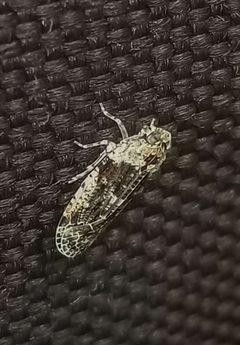
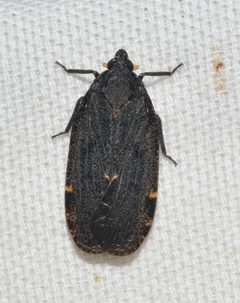
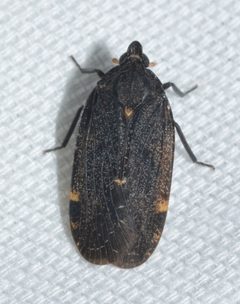
can be distinguished from other planthopper by a combination of wing venation characters, including the structure of C1 on the tegmen and the branching pattern of CuA on the hind wing. Some tribes exhibit unique modifications of the capsule, such as subdivision of the frontal area in Afrachilini. Male genitalia, particularly the structure of the , provide reliable specific characters for identification within . The and vertex shape, along with color and markings, are useful external diagnostic features.
Images
Habitat
occupy diverse across their broad geographic range. Members of the Epiptera are associated with conifers in North America. The South African Afrachilus montanifynbosensis inhabits montane fynbos vegetation. Australian species of Anabunda represent short-range endemics in eastern Queensland and New South Wales, where rapid urbanization threatens their persistence.
Distribution
has a distribution spanning multiple continents. Documented occurrences include North America (Canada, United States), South Africa (Western Cape), Australia (Queensland, New South Wales), China (Fujian, Guizhou, Yunnan, Hainan, Xizang, Chongqing provinces), and the United Arab Emirates. GBIF records indicate presence in Norway and Sweden. The Deferunda has its westernmost distribution point in the UAE, representing the first record from the Arabian Peninsula.
Host Associations
- conifers - associated with Epiptera in North America
Similar Taxa
- CixiidaeBoth belong to Fulgoroidea and share general planthopper ; differs in wing venation details including C1 structure and CuA branching on hind wing
- DerbidaeAnother of Fulgoroidea with similar body plan; can be distinguished by characteristic capsule modifications and male genitalia structure present in certain tribes
More Details
Subfamily classification
FLOW (Fulgoromorpha Lists on the Web) recognizes three : Achilinae (with tribes Achilini and Cixidiina), Apatesoninae (with four tribes), and Myconinae (with six tribes including Plectoderini and Rhotalini). A fourth tribe, Afrachilini, was described in 2025 within Myconinae.
Conservation concern
Some Australian , particularly in the Anabunda, represent short-range endemics potentially threatened by loss from rapid urbanization within their restricted ranges.
Taxonomic history
The was established by Stål in 1866. Historical confusion has existed among certain , notably Epiptera, due to misinterpretations of original descriptions leading to misidentifications in regional faunal records.
Sources and further reading
- BugGuide
- Wikipedia
- GBIF taxonomy match
- iNaturalist taxon
- NCBI Taxonomy
- Catalogue of Life
- The Canadian Species of Epiptera (Homoptera: Achilidae)
- Two new species of Anabunda Emeljanov (Hemiptera: Fulgoromorpha: Achilidae) from Australia
- Afrachilini trib. nov. of Achilidae from Southern Africa (Hemiptera: Fulgoromorpha: Fulgoroidea)
- The Planthopper family Achilidae (Hemiptera: Auchenorrhyncha: Fulgoroidea) in the United Arab Emirates
- Two new species of the planthopper genus Usana Distant, 1906 (Hemiptera, Fulgoromorpha, Achilidae) from China
- Four new species of the planthopper genus Catonidia Uhler, 1896 from China (Hemiptera: Fulgoromorpha: Achilidae)