
Hebetica
Stål, 1869
Species Guides
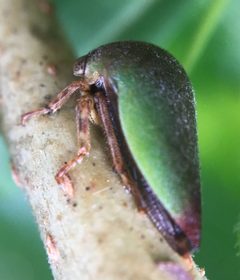
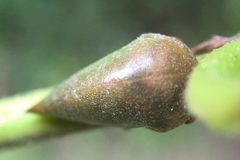
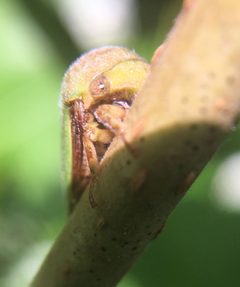
1Hebetica is a of treehoppers in the Membracidae, tribe Darnini. Members are commonly called 'raindrop treehoppers' due to their broadly rounded pronotum. The genus is predominantly Neotropical, with most distributed in South America. Hebetica sylviae is the sole Nearctic representative, discovered in the eastern United States in 2016.
Pronunciation
How to pronounce Hebetica: //hɛˈbɛtɪka//
These audio files are automatically generated. While they are not always 100% accurate, they are a good starting point.
Identification
Members of Hebetica can be distinguished from other Darnini by pronotal proportions: the pronotal length is less than twice the width between the humeral angles. The broadly rounded pronotum gives the body a raindrop-like silhouette. of H. sylviae are green or pale brown with darker apices, and have black contrasting with pale brown legs.
Images
Distribution
The Hebetica is primarily Neotropical, with distributed in South America. A single species, H. sylviae, occurs in the Nearctic region, known from Kentucky and Georgia in the eastern United States. An undescribed member of the genus has been reported from Mexico.
Host Associations
- Morus rubra - Native plant of H. sylviae
- Morus alba - Introduced plant adopted by H. sylviae
Behavior
Members of the tribe Darnini, including Hebetica, communicate through vibrational signals during courtship.
Similar Taxa
- StictopeltaAlso placed in tribe Darnini; shares the 'raindrop ' but differs in pronotal proportions and geographic distribution
More Details
Discovery of H. sylviae
The Nearctic H. sylviae was discovered serendipitously in 2016 when specimens were exposed by overwatering of a flower bed in Murray, Kentucky. The treehoppers had been buried underground by predatory (Hoplisoides costalis) as food for their larvae.
Taxonomic significance
Hebetica sylviae represents the first confirmed record of the tribe Darnini in the Eastern United States and is the only member of its in the Nearctic, separated from its closest relatives by over 1,600 km.