
Megophthalminae
Kirkaldy, 1906
Tribe Guides
2Megophthalminae is a of leafhoppers (Cicadellidae) established by Kirkaldy in 1906. It was historically treated as a separate or as the subfamily Agalliinae, but phylogenetic analyses have confirmed its placement within Cicadellidae. The subfamily includes four tribes: Adelungiini, Agalliini, Megophthalmini, and Evansiolini. Members are characterized by morphological convergence with treehoppers (Membracoidea), particularly in ocelli and wing modifications. The group originated in the early Cretaceous (~140 million years ago) and shows strong continental- biogeographic structure.
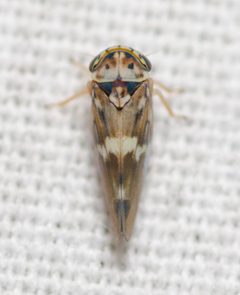
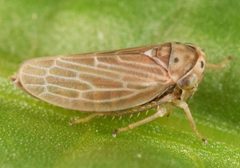
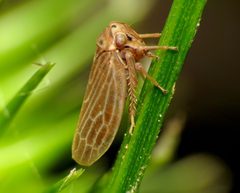
Pronunciation
How to pronounce Megophthalminae: /ˌmɛɡɒfˈθælmɪˌniː/
These audio files are automatically generated. While they are not always 100% accurate, they are a good starting point.
Identification
Distinguished from other Cicadellidae by combination of: structure with often enlarged or modified ocelli; wing venation patterns including variable crossvein development in claval region; male genitalia with distinctive connective, , and pygofer modifications. Convergent similarity to treehoppers (Membracidae, Aetalionidae, ) requires molecular or detailed morphological analysis for definitive placement. Tribe-level identification relies on head capsule structure, wing venation, and male genitalia configuration.
Images
Appearance
Leafhoppers with body forms ranging from typical cicadellid shape to -like morphologies. Some exhibit convergent modifications including: enlarged or modified ocelli; forewing and hindwing structural changes; reduced or absent wings in some lineages (e.g., flightless Diablophthalmus from Páramo ). Male genitalia often -diagnostic, with features such as spine-like processes on pygofer lobes, aedeagal shafts with paired processes or lamelliform expansions, and modified subgenital plates.
Habitat
Originally arboreal, inhabiting trees and shrubs. Multiple lineages have independently colonized leaf litter and soil microhabitats, accompanied by morphological adaptations including wing reduction. The flightless Diablophthalmus is restricted to high-elevation Páramo in northern South America.
Distribution
Widespread across major continental landmasses with strong regional faunas. Documented from: Asia (China, Vietnam, Pakistan, Iran, Japan); Africa (Morocco, Canaries); Europe; and the Americas (Mexico, Colombia, United States). Distribution patterns show continental clustering of related , indicating limited intercontinental .
Life Cycle
Hemimetabolous development with , nymph, and stages. Larval stage documented photographically in at least one (Assiuta salina).
Similar Taxa
- UlopinaeSister within Cicadellidae; both share -like morphological convergence and early Cretaceous origin. Distinguished by tribal composition and specific wing venation patterns.
- Membracidae (treehoppers)Convergent body form and microhabitat preferences; phylogenetically distinct within Membracoidea. Distinguished by presence of enlarged pronotum in most treehoppers and molecular phylogenetic placement.
- Aetalionidae and MelizoderidaeOther showing morphological convergence; distinguished by structure, wing coupling mechanisms, and molecular data.
More Details
Taxonomic history
Formerly treated as Megophthalmidae or as Agalliinae. Reclassification based on molecular phylogenetic studies using anchored hybrid enrichment and transcriptomic data. Inclusion of former Agalliinae contents under Megophthalminae reflects phylogenetic findings that Agalliini is deeply nested within this clade.
Phylogenetic instability
Relationships among Megophthalminae, Ulopinae, and true treehoppers (Aetalionidae, , Membracidae) remain unresolved across different analytical approaches, though monophyly of Megophthalminae itself is strongly supported.
Non-monophyletic tribes
Phylogenetic analyses recover Agalliini, Cephalelini, Megophthalmini, and Ulopini as non-monophyletic, indicating that current tribal classifications based on do not reflect evolutionary history.
Sources and further reading
- BugGuide
- Wikipedia
- iNaturalist taxon
- NCBI Taxonomy
- Catalogue of Life
- The leafhopper tribe Agalliini (Hemiptera: Cicadellidae: Megophthalminae) in Pakistan
- Leafhoppers of the tribe Adelungiini (Auchenorrhyncha: Cicadellidae: Megophthalminae) in Iran
- On the identity and distribution of Assiuta salina (Lindberg, 1954) (Hemiptera: Auchenorrhyncha: Cicadellidae; Megophthalminae)
- A new genus and species of Agalliini from China (Hemiptera, Cicadellidae, Megophthalminae)
- A new species of the genus Ceratagallia (Cicadellidae: Megophthalminae) from Central Mexico
- Description of Sangeeta sinuomacula sp. nov. (Hemiptera: Cicadellidae: Megophthalminae: Agalliini) from Yunnan Province of Southwest China
- A New genus of flightless leafhoppers (Hemiptera: Cicadellidae: Megophthalminae) from the Páramo of Northern South America
- Checklist and key to species of the leafhopper genus Japanagallia Ishihara, 1955 with description of a new species from China (Hemiptera: Cicadellidae, Megophthalminae)
- Extension of the leafhopper genus Multinervis (Hemiptera, Cicadellidae, Megophthalminae, Agalliini) from Northern to Central Vietnam, with the description of one new species
- Additions to Japanagallia Ishihara (Hemiptera, Cicadellidae, Megophthalminae) from Guizhou, and Yunnan Provinces, and Guangxi Autonomous Region, Southwest China
- Phylogeny, biogeography and morphological evolution of the treehopper‐like leafhoppers (Hemiptera: Cicadellidae) Megophthalminae and Ulopinae
- Description of mitochondrial genomes and phylogenetic analysis of Megophthalminae (Hemiptera: Cicadellidae).