
Hadoa
Moulds, 2015
Western Annual Cicadas
Species Guides
12- Hadoa bifida(Tablelands Sun-Singer)
- Hadoa chiricahua(Chiricahua Sun-Singer)
- Hadoa chisosensis(Southern Piñon Sun-Singer)
- Hadoa duryi(Orange-and-black Cicada)
- Hadoa inaudita(Dappled Sun-Singer)
- Hadoa longiopercula(Spade Sun-Singer)
- Hadoa montezuma(Aztec Sun-Singer)
- Hadoa neomexicensis(Sacramento Sun-Singer)
- Hadoa parallela(Corrupted Sun-Singer)
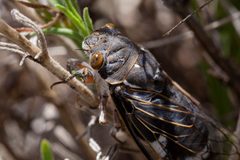
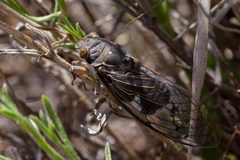
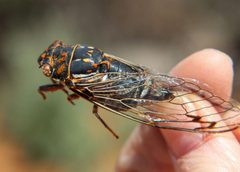
Hadoa is a of large-bodied cicadas ( Cicadidae) native to Western North America. The genus was erected in 2015 by Moulds to accommodate previously placed in Tibicen, which was redefined to include only European species. Hadoa species are annual cicadas, with typically emerging during summer months. The genus contains approximately 20 species distributed across western North American including deserts, woodlands, and montane regions.
Pronunciation
How to pronounce Hadoa: /ˈhɑ.do.ə/
These audio files are automatically generated. While they are not always 100% accurate, they are a good starting point.
Identification
Hadoa can be distinguished from the related eastern North American Neotibicen and European genus Tibicen by geographic distribution and subtle morphological differences in genitalia and wing venation patterns. Within western North America, Hadoa species may be distinguished from other genera such as Okanagana and Diceroprocta by their generally larger body size and distinct calling songs. Specific species identification typically requires examination of male genitalia and detailed acoustic analysis of male calling songs.
Images
Habitat
Hadoa occur in diverse across Western North America including desert scrublands, pinyon-juniper woodlands, oak woodlands, montane coniferous forests, and riparian corridors. Specific habitat associations vary by species, with some tied to particular plant or elevations.
Distribution
Western North America, including the southwestern United States (Arizona, New Mexico, Texas, Colorado, Utah, Nevada, California) and adjacent regions of northern Mexico. The is to this region and does not occur in eastern North America or Europe.
Seasonality
are active primarily during summer months, typically from June through August depending on elevation and local climate conditions. As annual cicadas, emerge each year rather than in periodic cycles.
Life Cycle
Hadoa have a typical with laid in plant tissue, nymphal development underground feeding on xylem fluids from plant roots, and of winged . As annual cicadas, the life cycle completes in approximately 2-5 years rather than the 13- or 17-year cycles of periodical cicadas (Magicicada).
Behavior
Males produce -specific calling songs to attract females. are active during daylight hours and are frequently observed on vegetation or singing from elevated perches.
Ecological Role
As xylem-feeders, nymphs and extract fluids from plant vascular tissues, with minimal known economic impact. Adults serve as prey for various vertebrate and .
Human Relevance
Hadoa cicadas contribute to the summer soundscape of western North American landscapes and are subjects of ecological and bioacoustic research. They are not known to cause significant agricultural damage.
Similar Taxa
- NeotibicenFormerly grouped with Hadoa in the broadly defined Tibicen; distinguished by eastern North American distribution
- TibicenNow restricted to European ; distinguished by Palearctic distribution
- DiceroproctaOverlapping western North American distribution; distinguished by different calling songs and morphological features
- OkanaganaOverlapping western North American distribution; generally smaller body size and different