
Cylindrotoma distinctissima
Meigen, 1818
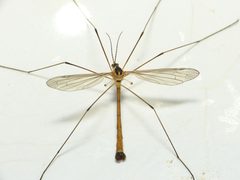
Cylindrotoma distinctissima is a of crane fly in the Cylindrotomidae, a small family of primitive crane flies. The species is broadly distributed across the Palearctic region, ranging from Western Europe through Russia to East Asia including Japan. are typically associated with moist woodland and riparian . The family Cylindrotomidae is characterized by larvae that feed on mosses, distinguishing them from most other crane fly families.

Pronunciation
How to pronounce Cylindrotoma distinctissima: /sɪˌlɪn.drəˈtoʊ.mə dɪˌstɪŋkˈtɪs.ɪmə/
These audio files are automatically generated. While they are not always 100% accurate, they are a good starting point.
Identification
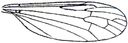
can be distinguished from other European crane flies by the combination of: fully developed wings with distinct venation; body coloration typically featuring yellow and black patterning; and the structure of the , which have 16 segments. The Cylindrotomidae is separated from related Tipulidae by the presence of only two ocelli (instead of three) and the distinctive larval on mosses rather than soil or decaying matter. Separation from the other Cylindrotoma requires examination of male genitalia and detailed wing venation patterns.
Images
Habitat
Moist woodland environments, particularly riparian zones and areas with abundant moss growth. Larval development occurs exclusively on mosses, typically in shaded, humid locations. are found in vegetation near larval development sites.
Distribution
Western, Central and Eastern Europe including Austria, Belarus, Belgium, Bulgaria, Croatia, Czech Republic, Denmark, Estonia, Finland, France, Germany, Great Britain, Hungary, Ireland, Italy, Lithuania, Luxembourg, Netherlands, Norway, Poland, Romania, Serbia, Slovakia, Slovenia, Spain, Sweden, Switzerland, and Ukraine. Extends eastward through Russia including northern European Russia, the Caucasus, Siberia, Altay, Primorskiy Krai, and Sakhalin including Kuril Islands. Also recorded from Turkey (Manisa), Kazakhstan, Mongolia, and Japan (Hokkaido, Honshu, Kyushu).
Diet
Larvae feed on mosses (Bryophyta). feeding habits have not been documented.
Life Cycle
Complete with , larva, pupa, and stages. Larvae develop on living mosses, an unusual habit among crane flies. occurs in the moss substrate. Specific timing of developmental stages varies with latitude and local climate conditions.
Behavior
are active during daylight hours and have been observed resting on vegetation. Larvae are restricted to moss surfaces and do not burrow into soil.
Ecological Role
Larvae function as primary consumers of moss tissue, representing a specialized herbivore among crane flies. The contributes to nutrient cycling in moist woodland through processing of bryophyte .
Similar Taxa
- Tipulidae (typical crane flies)Superficially similar but distinguished by three ocelli versus two in Cylindrotomidae, and larvae are soil-dwelling rather than moss-feeding.
- Cylindrotoma other speciesRequires examination of male terminalia and detailed wing venation; C. distinctissima is the most widespread and frequently encountered European in the .