
Tritoxa incurva
Loew, 1873
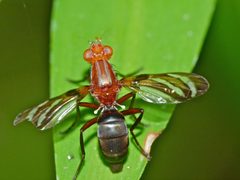
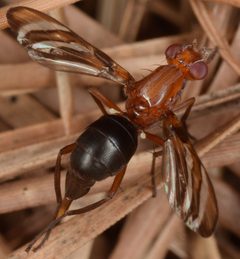
Tritoxa incurva is a of picture-winged fly in the Ulidiidae, originally described by Loew in 1873. It is one of seven recognized species in the Nearctic Tritoxa, distinguished by its bold wing patterns. The species occurs in the eastern United States, where are active from May through October in grassy meadow .
Pronunciation
How to pronounce Tritoxa incurva: /traɪˈtɑk.sə ɪnˈkɜr.və/
These audio files are automatically generated. While they are not always 100% accurate, they are a good starting point.
Identification
Distinguished from other Tritoxa by wing patterns. Among sympatric species, male genitalia examination is required for confident identification. The rusty-brown coloration and bold wing patterning are characteristic of this species in the eastern part of its range.
Images
Habitat
Grassy meadows. Specific microhabitat requirements are not documented.
Distribution
Eastern United States. The is part of a Nearctic with seven recognized species, but detailed distribution records beyond the general eastern U.S. region are not provided in available sources.
Seasonality
active from May through October.
Life Cycle
and stages have been documented in Allen & Foote (1975), though specific details are not reproduced in available source material.
Similar Taxa
- Tritoxa cuneataSympatric congeneric in the Nearctic Tritoxa; wing patterns and male genitalia differ
- Tritoxa flexaSympatric congeneric in the Nearctic Tritoxa; wing patterns and male genitalia differ
- Tritoxa pollinosaSympatric congeneric in the Nearctic Tritoxa; wing patterns and male genitalia differ
More Details
Taxonomic history
Originally described by Loew in 1873. Included in a 2021 revision of the Nearctic Tritoxa that recognized seven , including two newly described species (T. californica and T. decipiens). One additional species from California and Nevada based on female specimens remains undescribed.
Identification resources
A key to all Tritoxa was provided in the 2021 revision, with species illustrations and distribution maps. Wing patterns are the primary diagnostic feature for field identification.
Sources and further reading
- BugGuide
- Wikipedia
- GBIF taxonomy match
- iNaturalist taxon
- NCBI Taxonomy
- Catalogue of Life
- Lepidoptera | Beetles In The Bush | Page 7
- Uncategorized | Blog - Part 41
- Pensoft blog - Part 147
- Bibliography | Beetles In The Bush
- The giant cockroach genus Pseudophoraspis expands to the north with 3 new species | Blog
- Revision of the Nearctic genus Tritoxa Loew (Diptera: Ulidiidae)