
Rhagoletis zephyria
Snow, 1894
snowberry maggot, western cherry fruit fly
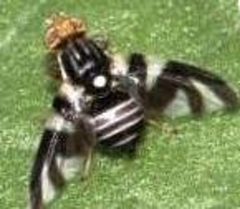
Rhagoletis zephyria is a tephritid fruit fly native to western North America, commonly known as the snowberry maggot. It is a of the economically significant apple maggot (R. pomonella), with which it shares substantial morphological similarity and a history of occasional hybridization. The is specialized on snowberry (Symphoricarpos spp.) as its primary , and exhibits distinct timing that contributes to reproductive isolation from R. pomonella. R. zephyria is not considered an agricultural pest, though its visual similarity to R. pomonella creates identification challenges for regulatory monitoring.
Pronunciation
How to pronounce Rhagoletis zephyria: /ræɡoʊˈliːtɪs zɛˈfɪriə/
These audio files are automatically generated. While they are not always 100% accurate, they are a good starting point.
Identification
Externally nearly identical to Rhagoletis pomonella; reliable discrimination requires examination of male genitalia or female . Males: surstylus shape differs—R. zephyria shows parallel or divergent surstylus configuration, whereas R. pomonella consistently displays inwardly curved surstyli (width ratio across prensisetae bases to outer edges near tips). Females: aculeus shape and length combined provide 94.5% classification ; aculeus shape alone correctly identifies 85.3% of specimens. Visual inspection of wing patterns insufficient for definitive identification due to extensive overlap.
Images
Habitat
Associated with snowberry (Symphoricarpos spp.) shrubs in temperate regions; specific requirements beyond plant presence not documented in available sources.
Distribution
Native to western North America; documented from Washington, Oregon, and the Great Lakes Basin. Western occur in sympatry with introduced Rhagoletis pomonella.
Diet
Larval development occurs within snowberry fruit; feed on fruit surfaces and associated resources, though specific adult dietary components not documented.
Host Associations
- Symphoricarpos albus - primary confirmed for western ; specifically Symphoricarpos albus laevigatus
- Symphoricarpos spp. - primary -level association across native range
Life Cycle
Overwinters as pupa in soil; timing regulated by chill duration and temperature. Eclosion occurs significantly earlier in the than R. pomonella, with peak 2–3 hours after lights-on under laboratory conditions. Chill durations of 130–180 days at ~3°C promote adult emergence; unchilled show very low eclosion rates (1.2–1.9%).
Behavior
exhibit upwind oriented toward fruit volatile blends, with strong specificity for snowberry-derived compounds. Key attractant components include 1-octen-3-ol and (3E)-4,8-dimethyl-1,3,7-nonatriene (DMNT); removal of either significantly reduces flight response. Host odor discrimination contributes to prezygotic reproductive isolation and sympatric host plant shifts.
Ecological Role
Human Relevance
Not an agricultural pest; poses identification challenges for apple maggot survey programs due to morphological similarity to Rhagoletis pomonella. Accurate discrimination critical for and management decisions affecting commercial apple production.
Similar Taxa
- Rhagoletis pomonella with extensive morphological overlap; distinguished by male surstylus configuration, female shape and size, and timing. R. pomonella attacks Rosaceae (apple, hawthorn) versus R. zephyria on Caprifoliaceae (snowberry).
- Rhagoletis mendaxMember of R. pomonella complex; not discussed in detail in provided sources but represents additional identification challenge within this group.
Sources and further reading
- BugGuide
- Wikipedia
- GBIF taxonomy match
- iNaturalist taxon
- NCBI Taxonomy
- Catalogue of Life
- Distinct Adult Eclosion Traits of Sibling SpeciesRhagoletis pomonellaandRhagoletis zephyria(Diptera: Tephritidae) Under Laboratory Conditions
- Analysis of Surstylus and Aculeus Shape and Size using Geometric Morphometrics to DiscriminateRhagoletis pomonellaandRhagoletis zephyria(Diptera: Tephritidae)
- Identification of Host Fruit Volatiles from Snowberry (Symphoricarpos albus), Attractive to Rhagoletis zephyria Flies from the Western United States
- OPIINE PARASITOIDS (HYMENOPTERA: BRACONIDAE) OF RHAGOLETIS POMONELLA AND R. ZEPHYRIA (DIPTERA: TEPHRITIDAE) IN THE WILLAMETTE VALLEY, OREGON
- <I>Rhagoletis zephyria</I> (Diptera: Tephritidae) in the Great Lakes Basin: a Native Insect on Native Hosts?
- Implications ofRhagoletis zephyriaSnow, 1894 (Diptera: Tephritidae) captures for apple maggot surveys and fly ecology in Washington State, U.S.A.
- Sensitivities to Chill Durations and No-Chill Temperatures Regulating Eclosion Responses Differ Between Rhagoletis zephyria (Diptera: Tephritidae) and its Braconid Parasitoids (Hymenoptera: Braconidae)
- The population genetics of the apple maggot fly, Rhagoletis pomonella and the snowberry maggot, R. zephyria: implications for models of sympatric speciation