
Rhagoletis mendax
Curran, 1932
blueberry maggot, blueberry maggot fly
Rhagoletis mendax, commonly known as the blueberry maggot, is a tephritid fruit fly native to eastern North America and a major pest of cultivated and wild blueberries (Vaccinium spp.) and related Ericaceae. The completes a in most regions, with emerging in spring or summer to oviposit in ripening berries; larvae feed internally, destroying fruit marketability. It is closely related to the apple maggot (R. pomonella), with which it is reproductively isolated primarily through -specific chemical cues despite morphological similarity and laboratory interfertility. Management relies on predictive models, monitoring with baited sticky traps, and targeted applications.
Pronunciation
How to pronounce Rhagoletis mendax: /ræˈɡoʊlɛtɪs ˈmɛndæks/
These audio files are automatically generated. While they are not always 100% accurate, they are a good starting point.
Identification
are distinguished from other Rhagoletis , particularly the sympatric apple maggot (R. pomonella), by wing banding ratios, ovipositor length, and male genitalia—features requiring taxonomic keys or biochemical methods such as for definitive identification. Visual separation of stages from is generally not possible. The characteristic "F"-pattern wing banding and scutellar spot aid field recognition, though confirmation typically requires expert examination or molecular testing.
Images
Appearance
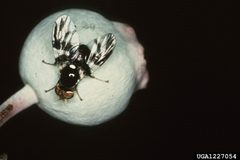
are small fruit flies with distinctive wing patterning. Females measure approximately 4.75 mm in length with an 8 mm wingspan; males are slightly smaller. The body is predominantly black with a conspicuous white spot covering the scutellum and white stripes on either side of the . The female is pointed with four horizontal bands of fine white setae; the male abdomen is more rounded with three bands. The is dominated by large orange-red , with protruding aristate . The single pair of wings is clear with conspicuous dark black bands arranged in an "F" pattern. Larvae are 5–8 mm long, apodous, off-white with large preoral teeth, a cone-shaped sensory organ at the head, and large anal lobes with paired on the blunt . The is brown.
Habitat
Occurs in commercial blueberry fields, wild lowbush blueberry barrens, and forest edges supporting Vaccinium and Gaylussacia . In eastern Canada, levels correlate positively with weed growth intensity. are active on plant foliage during daylight hours, flying at low altitude just above the crop .
Distribution
Native to eastern North America. In the United States, distributed from Florida and Georgia northward through the Mid-Atlantic and New England states, extending west to Minnesota and Wisconsin. In Canada, present in New Brunswick, Nova Scotia, Prince Edward Island, Ontario, and Quebec. Absent from Newfoundland and Labrador. Northern distribution limits in eastern Canada are constrained by .
Seasonality
emerge from soil in spring or summer, coinciding with or slightly preceding fruit ripening. Approximately 90% of occurs within a one-month window. Females emerge 4–5 days before males at peak fruit availability. In southern parts of the range, emergence may be delayed to summer due to heat-induced pupal . occurs from July (south) to late September (north).
Diet
feed on dew, insect honeydew, and foliar secretions prior to sexual maturation. Larvae feed exclusively on the flesh of developing berries of plants. Adults have been observed to be attracted to volatiles from Enterobacter (Pantoea) agglomerans bacteria on host foliage, potentially obtaining nitrogen necessary for ovarian maturation.
Host Associations
- Vaccinium corymbosum - highbush blueberry
- Vaccinium angustifolium - lowbush blueberry
- Vaccinium macrocarpon - cranberry
- Vaccinium vitis-idaea - lingonberry
- Gaylussacia - huckleberry
- Enterobacter agglomerans - epiphytic nitrogen-fixing bacteria; attracted to volatiles, may provide nitrogen for ovarian development
- Diachasma alloeum - braconid of larvae
Life Cycle
Holometabolous with four stages: , larva, pupa, and . Females deposit a single egg per berry using a retractable ovipositor, leaving a - that deters oviposition for several days. Eggs hatch in 3–7 days; larvae pass through three instars over 17–30 days, consuming the entire fruit. Third-instar larvae exit fruit, drop to soil, and pupate at 25–50 mm depth. Most are ; in Maine, approximately 85% univoltine with 10% requiring three winters and 5% four winters as pupae. Evidence suggests approximately 1% of some populations may produce a partial second . Adult lifespan is 30–45 days or longer; females become reproductively mature at approximately 15 days and remain fertile to approximately 45 days, weather-dependent.
Behavior
Males patrol plant foliage and engage in aerial pursuit of females; mating occurs on host plants. Males exhibit site fidelity to particular host plants and interact aggressively with other males through chasing and aerial collisions. are diurnally active with continuous during daylight hours; activity occurs but does not result in trap capture. is characterized by nondirectional short-distance flight at low altitude; proceeds as a slow wave penetrating field interiors over the season, with flies accumulating along field edges. Movement rates of 9.7–28.0 m/day have been documented. Females use wind-borne cues to orient toward host plants and exhibit upwind flight toward odor sources.
Ecological Role
Primary consumer of Ericaceae fruits in its native range. Serves as for the Diachasma alloeum. Acts as a competitor with the spotted-wing drosophila (Drosophila suzukii), with which it is being displaced in some regions due to the invader's multivoltine and earlier reproductive readiness.
Human Relevance
Major economic pest of blueberry crops, causing fruit damage, premature drop, and complete loss of marketability through larval . Subject to regulations by CFIA, USDA-APHIS, and EPPO (A1 list). Management integrates models (developmental threshold 6.1°C), ammonium acetate-baited yellow sticky traps for monitoring, cultural practices (removal of overripe fruit), and applications timed 5–7 days after first capture. Spinosyn-based insecticides and attract-and-kill traps are employed in control programs. Displacement by Drosophila suzukii is altering pest management regimes in affected regions.
Similar Taxa
- Rhagoletis pomonella with overlapping geographic range and morphological similarity; distinguished by association (apple/hawthorn vs. blueberry), wing banding ratios, genitalia, and -specific ; reproductive isolation maintained by host odor discrimination despite laboratory interfertility.
- Drosophila suzukii competitor in blueberry agroecosystems; distinguished by serrated ovipositor allowing -laying in unripe fruit, multivoltine , , and earlier reproductive maturity; R. mendax is with pupal and requires 1–2 weeks post- before oviposition.
More Details
Genetic differentiation
demonstrates that R. mendax and R. pomonella are genetically distinct , with 11 of 29 loci showing -specific . No evidence of hybridization or nuclear gene has been detected in sympatric field , supporting via -race formation.
Climate change impacts
Warming trends appear to indirectly disadvantage R. mendax through competitive interactions rather than direct thermal effects. Longer growing seasons and milder winters favor larger of the Drosophila suzukii, which outcompetes R. mendax; the native has shown declining trap catches concurrent with increasing D. suzukii captures.
Dispersal limitations
Natural spread occurs primarily through short-distance ; long-range is mediated by human transport of infested fruit or contaminated growing media containing pupae. Screen fencing at field edges can reduce by exploiting the ' low flight altitude.
Sources and further reading
- BugGuide
- Wikipedia
- GBIF taxonomy match
- iNaturalist taxon
- NCBI Taxonomy
- Catalogue of Life
- CDFA to Host Fruit Fly Workshop, Free to Participants | Bug Squad
- Hot Competition: Climate Change, Invasive Fly Displace a Native Blueberry Pest
- Blueberry Maggot, Rhagoletis mendax Curran
- Rhagoletis mendax . [Distribution map].
- Mating Behavior of Rhagoletis mendax (Diptera: Tephritidae) Flies in Nature1
- Collection of host-marking pheromone from Rhagoletis mendax (Diptera: Tephritidae)
- UPDATE ON THE DISTRIBUTION OF THE BLUEBERRY MAGGOT, RHAGOLETIS MENDAX (DIPTERA: TEPHRITIDAE), IN CANADA
- Abiotic and biotic factors affecting Rhagoletis mendax [Diptera :Tephritidae] populations in eastern Canadian lowbush blueberry fields
- Impaired host odor perception in hybrids between the sibling species Rhagoletis pomonella and R. mendax
- Host-selection Behavior Differences between the Fruit Fly Sibling Species Rhagoletis pomonella and R. mendax (Diptera: Tephritidae)
- Control strategies for Rhagoletis mendax disrupt host-finding and ovipositional capability of its parasitic wasp, Diachasma alloeum
- Sex-biased trap capture and odor-stimulated upwind flight in the field by Rhagoletis mendax (Diptera: Tephritidae)
- Factors limiting the northern distribution of the blueberry maggot, Rhagoletis mendax (Diptera: Tephritidae) in Eastern Canada
- Rethinking Blueberry Maggot (Rhagoletis mendax(Curan)) Distribution and Abundance in North Carolina: When Area Wide Management Is Unintentional
- Movement of Rhagoletis mendax (Diptera: Tephritidae) in Fruit-Bearing Wild Blueberry Fields. Part II
- Are the apple maggot, Rhagoletis pomonella, and blueberry maggot, R. mendax, distinct species? Implications for sympatric speciation
- Sampling highbush blueberries for Rhagoletis mendax (Diptera: Tephritidae) reveals shifting activity timing and cultivar susceptibility.