
Paracantha gentilis
Hering, 1940
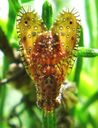
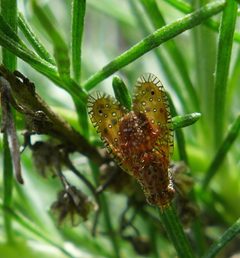
Paracantha gentilis is a tephritid fruit fly described by Hering in 1940 from Wyoming specimens. The species has a complex taxonomic history, with several described by Malloch in 1941 (mimetica, mimetica elongata, mexicana) and Aczél in 1953 (sobrina) later synonymized under P. gentilis when wing pattern variation proved continuous rather than discrete. It is the first Tephritidae species in which the oral lobe of larvae was described, a character now known to be shared by all non-frugivorous Tephritinae. The species exhibits a with distinct behavioral and morphological adaptations for exploiting Cirsium thistle flowerheads.
Pronunciation
How to pronounce Paracantha gentilis: //ˌpærəˈkænθə ˈdʒɛntɪlɪs//
These audio files are automatically generated. While they are not always 100% accurate, they are a good starting point.
Identification
Distinguished from the similar Paracantha culta by smaller spots on the ; P. culta is widespread in the Southeastern United States while P. gentilis occurs in the Western United States with range overlap in Texas. Historically confused with P. mimetica, P. mimetica elongata, P. mexicana, and P. sobrina, all now synonymized; these were originally separated based on wing pattern characters that proved to represent continuous variation. Modern identification relies on terminalia rather than wing patterns. Differs from P. genalis by greater abundance and more extensive documented .
Images
Habitat
Associated with Cirsium thistle plants in various across western North America. found on Cirsium plants where feeding, mating, and oviposition occur. Larval development restricted to closed and developing capitula (flowerheads) of Cirsium . Some adults disperse to higher elevations and non- plants during summer period.
Distribution
Widespread throughout the Western United States; extends south to Mexico and Rica. Range overlaps with Paracantha culta in Texas, where both have been documented at the same site. Western distribution complements the eastern distribution of P. culta.
Seasonality
with two per year. First generation: overwintered adults appear late March to early May. Second generation: same-year adults emerge late June. Some adults of the second generation enter reproductive , move to higher elevations and non- plants during midsummer, and overwinter to become the first generation the following year. occurs in late summer or extends into early spring depending on timing.
Diet
feed on sap at oviposition wounds in Cirsium thistles. Larvae feed on Cirsium flowerhead tissues: first and second instars tunnel in floral tubes and hardened plant material; third instars feed at central ovules or extract sap from depressions in the upper receptacle using the oral lobe.
Host Associations
- Cirsium arizonicum - larval including as Cirsium nidulum
- Cirsium brevistylum - larval
- Cirsium centaureae - larval
- Cirsium ciliolatum - larval
- Cirsium cymosum - larval
- Cirsium douglasii - larval
- Cirsium edule - larval
- Cirsium fontinale var. campylon - larval as Cirsium campylon
- Cirsium hydrophilum var. vaseyi - larval
- Cirsium mexicanum - larval
- Cirsium mohavense - larval
- Cirsium occidentale - larval including varieties californicum, candidissimum, occidentale, and venustum
- Cirsium ochrocentrum - larval
- Cirsium parryi - larval
- Cirsium remotifolium - larval as Cirsium callilepis
- Cirsium scariosum - larval including varieties americanum, coloradense, congdonii, and scariosum
- Cirsium texanum - larval
- Cirsium undulatum - larval
- Cirsium vulgare - larval
Life Cycle
Complete with , three larval instars, pupa, and . Eggs deposited in groups of 1–13 in capitula; exposed to air for respiration. First instar larvae tunnel to separate floral tubes within capitulum, feeding only there; do not induce gall formation. Second instars leave floral tubes, tunnel through hardened plant material toward outer margin of capitulum. Third instars develop by anthesis; feed at central ovules or create depressions in upper receptacle for sap extraction using oral lobe. Larvae prepare for pupariation by turning toward top of capitula, pupating at center surrounded by dried florets. Adults emerge by expanding to break and pushing aside florets; adults rest on capitulum exterior ~30 minutes, excreting dark metabolic waste 1–2 times.
Behavior
exhibit territorial defense of sap-feeding sites on Cirsium, lunging at ants while audibly buzzing wings. Engage in "agnostic" wing (slow, asynchronous movements without apparent communicative function) and "bubbling" (ejecting and re-ingesting liquid droplets, possibly for temperature regulation). Males establish territories on lower Cirsium leaves, displaying with copied wing movements and labellar contact when intruding males approach; may release from distended or maxillary palp gland. Courtship involves male extending mouthparts, producing off-white liquid droplet on , vibrating labellum while female observes; female may accept and ingest droplet through labellar contact for up to 20 minutes, or reject and depart. Mating initiated when female extends ovipositor acleus during labellar contact; male mounts ovipositor dorsally and remains in copula 2.5–4 hours on shaded leaves. Adults visually orient toward Cirsium plants before jumping and flying to new . Females probe capitulum centers with ovipositor, depositing in both uninfested and already-infested capitula without avoidance.
Ecological Role
Primary consumer of Cirsium flowerhead tissues; does not induce gall formation unlike many other Tephritidae. Third instar larvae and pupae protected by mixture of dried and plant debris, which may reduce or desiccation. Serves as for Pteromalus canadensis (Pteromalidae), which oviposits in larvae and consumes pupae. Competes for host resources with other Cirsium-feeding Tephritidae including native Terellia occidentalis and introduced Chaetostomella undosa; avoids by earlier attack timing and use of capitulum center. Often first herbivore to reach and oviposit in capitula, followed by T. occidentalis and Phycitodes mucidella. More prolific than competitors, with 55.6% seed rate versus 5.6% for C. undosa in one study.
Human Relevance
Potential pest of globe artichoke in California, though this record may represent misidentification of P. culta; no subsequent damage reports on non-Cirsium . Used as model organism for studying tephritid larval , particularly the oral lobe structure. Taxonomic history illustrates challenges of using wing patterns versus terminalia for delimitation in Tephritidae.
Similar Taxa
- Paracantha cultaSimilar and ; distinguished by larger spots and eastern US distribution; ranges overlap in Texas
- Paracantha genalisOverlapping western distribution and Cirsium use; much rarer and less studied
- Paracantha mimeticaOriginally described as separate based on wing patterns; synonymized under P. gentilis when variation proved continuous
- Paracantha mexicanaOriginally described as separate based on wing patterns; synonymized under P. gentilis
- Paracantha sobrinaOriginally described from Rica as separate ; synonymized under P. gentilis without explicit reasoning in systematic database
Misconceptions
Historical misconception that wing pattern variants represented discrete (mimetica, mimetica elongata, mexicana, sobrina) rather than continuous variation within P. gentilis. Reported damage to globe artichoke in California attributed to P. culta may actually involve P. gentilis, but this remains unconfirmed and no subsequent reports document P. gentilis attacking this non-Cirsium .
More Details
Taxonomic history
First described by Hering in 1940 from Wyoming specimens. Malloch (1941) described three new (mimetica, mimetica elongata, mexicana) based largely on wing patterns. Aczél (1953) synonymized these with P. gentilis after finding wing pattern variation represented a continuous gradient. Systematic database of Tephritidae later confirmed these synonymies and additionally synonymized P. sobrina without explicit reasoning.
Larval morphology significance
First Tephritidae in which the oral lobe was described; this structure has since been found in all non-frugivorous Tephritinae and is used for liquid food uptake in third instar larvae.
Parasitoid relationship
Pteromalus canadensis is the only reported ; larva does not kill fly larva until pupariation, then consumes pupa and uses hollowed for its own .
Competitive interactions
avoided through temporal and spatial partitioning: P. gentilis attacks earlier and uses capitulum center, while later arrivals (T. occidentalis, P. mucidella, C. undosa) use different tissues or stages.