
Aciurina trixa
Curran, 1932
Bubble-gall tephritid
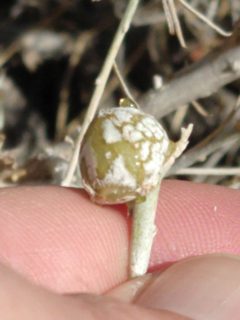
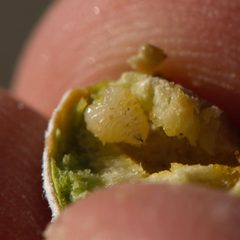
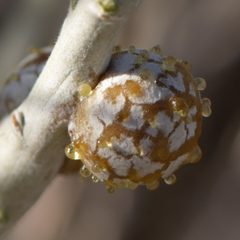
Aciurina trixa is a gall-forming tephritid fly that induces spheroidal bud galls on plants in the Chrysothamnus (Asteraceae). It is multivoltine with three larval instars, typically producing one larva per gall. The exhibits : females are larger overall, while males possess enlarged forefemora that predict copulatory success. It is unusually common and abundant in New Mexico and Arizona, where it supports complex including 24 associated species across 6 guilds.
Pronunciation
How to pronounce Aciurina trixa: /ˌæ.siˈʊr.ɪ.nə ˈtrɪk.sə/
These audio files are automatically generated. While they are not always 100% accurate, they are a good starting point.
Identification
Distinguished from its sister Aciurina bigeloviae by distinct gall ; A. trixa produces spheroidal bud galls while A. bigeloviae forms different gall types. Both species occur in sympatry in New Mexico. Females are larger than males in overall body size, but males have conspicuously enlarged forefemora. Gall location on buds of previous-year stems may aid identification.
Images
Habitat
Northern and central New Mexico and northern Arizona, USA; specifically documented at Schultz Pass near Flagstaff, Arizona at 2,400 m elevation. Associated with plants in dryland shrub .
Distribution
United States: northern and central New Mexico, and northern Arizona (Flagstaff area).
Seasonality
activity and oviposition occur between 9:00 am and 5:00 pm on sunny days. has been documented but specific seasonal timing is not detailed in available sources. Multivoltine suggests activity across multiple periods per year.
Diet
Larvae develop inside spheroidal bud galls induced on plant tissue; feeding occurs within the gall structure on plant material.
Host Associations
- Chrysothamnus nauseosus hololeucus - plant of rubber rabbitbrush; primary for gall induction in Arizona study
- Chrysothamnus nauseosus - plantfive total documented as per literature
Life Cycle
Multivoltine. laid on buds of stems that grew in the previous year. Three larval instars; only one larva per gall. Larva induces spheroidal bud gall after hatching. documented but specific timing not detailed.
Behavior
Females exhibit sequential plant evaluation , accepting or rejecting plants during host-searching. Acceptance is recorded when the female curls her and extrudes the ovipositor. Under natural conditions, females generally do not remain longer than 10 minutes on unsuitable plants. Females laid fewer and spent longer time ovipositing on unfertilized control plants compared to NPK-fertilized plants. Males use enlarged forefemora to seize females prior to mounting; forefemur size predicts copulatory success.
Ecological Role
Gall-forming herbivore that acts as an engineer. Induced galls serve as novel structural supporting 24 associated across 6 guilds (, , ), making its richer and more complex than other documented Tephritidae-Asteraceae galling systems. The abundant inquiline weevil Anthonomus cycliferus co-occurs in galls but has no measurable effect on fly size or gall size.
Similar Taxa
- Aciurina bigeloviaeSister with sympatric distribution in New Mexico; distinguished by distinct gall
- Valentibulla dodsoniCo-occurs in same study systems; both exhibit similar pattern with male forefemur enlargement predicting mating success
More Details
Research significance
One of the most thoroughly studied Aciurina due to its unusual abundance and accessibility in the southwestern United States. Serves as a model for studying gall-inducer plant selection, in mating systems, and associated with gall structures.
Common name origin
Referred to as 'bubble-gall tephritid' on iNaturalist, referencing the characteristic spheroidal gall shape.
Sources and further reading
- BugGuide
- Wikipedia
- GBIF taxonomy match
- iNaturalist taxon
- NCBI Taxonomy
- Catalogue of Life
- Arthropod communities associated with gall-inducing Aciurina bigeloviae and Aciurina trixa (Diptera: Tephritidae) in New Mexico
- Arthropod communities associated with gall-inducing Aciurina bigeloviae and Aciurina trixa (Diptera: Tephritidae) in New Mexico
- Response of the galling insect Aciurina trixa Curran (Diptera: Tephritidae) to host plant quality
- The significance of sexual dimorphism in the mating system of two species of tephritid flies (Aciurina trixa and Valentibulla dodsoni) (Diptera: Tephritidae)