
Haematopota
Meigen, 1803
Clegs
Species Guides
2- Haematopota americana(horse fly)
- Haematopota rara(Lace-winged Horse Fly)
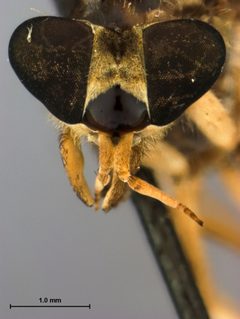
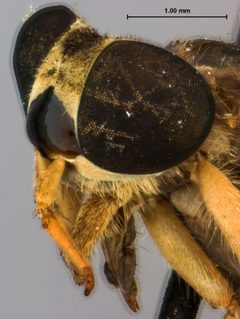
Haematopota is a of horse-flies ( Tabanidae) commonly known as clegs. The genus name derives from Greek roots meaning 'blood-drinker.' Many exhibit distinctive patterned that fade after death, and wings typically display grey spotting. Species in this genus are and include significant livestock .
Pronunciation
How to pronounce Haematopota: /ˌhiːməˈtɒpətə/
These audio files are automatically generated. While they are not always 100% accurate, they are a good starting point.
Identification
Distinguished from other horse-fly by the combination of patterned (in life) and grey-spotted wings. The eye pattern fades post-mortem, making identification of preserved specimens more challenging. Specific identification requires examination of additional morphological characters not consistently documented across the genus.
Images
Appearance
Medium to large horse-flies with robust bodies. Many possess colorful, sinuously patterned that are vivid in living specimens but fade rapidly after death. Wings characteristically patterned with spots of grey. Body coloration and patterning varies among species.
Habitat
Various from lowlands to mountains. Frequently associated with flowing waters and water . Open with access to mammalian .
Distribution
Widely distributed across Eurasia. Documented in Denmark, Norway, Sweden, Poland, Hungary, Czech Republic, Croatia, and Spain. Specific show geographic variation in abundance patterns.
Seasonality
Seasonal abundance during late spring and summer. Peak occurrence varies geographically: early to late June in Croatia, first half of July in Hungary, mid to late July in Northern Spain, July to August in Poland.
Diet
. Females require blood meals. In Haematopota pluvialis, females are telmophagous (pool feeders) that take brief, repeated bites from multiple to complete a single blood meal.
Host Associations
- humans - bitten for blood mealscauses painful bites with local skin , erythematous-edematous reactions, pruritus, burning sensation, acute urticarial reactions
- animals - bitten for blood mealslivestock and wild mammals
- multiple hosts - required for single blood meal completioninterrupted feeding pattern with brief repeated bites from different
Life Cycle
Seasonal abundance during late spring and summer. Peak occurrence timing varies by geographic location. Detailed developmental stages not documented at level.
Behavior
Biting activity predominantly during daylight hours. Telmophagous (pool feeding) with interrupted feeding pattern requiring multiple contacts to complete blood meal. Painful bites cause significant nuisance to humans and animals.
Ecological Role
Mechanical of including viruses (bovine viral diarrhea virus, lumpy skin virus), bacteria (Bartonella spp.), and protozoa. Potential bridge for zoonotic transmission due to feeding on both humans and animals.
Human Relevance
Significant nuisance pest causing painful bites with local and reactions. Mechanical of livestock . Haematopota pluvialis identified as tabanid in Europe, creating substantial economic and welfare impacts on animal husbandry.
Similar Taxa
- other Tabanidae generaHaematopota distinguished by patterned (in life) and grey-spotted wings; other horse-fly generally lack this specific eye and wing pattern combination
More Details
Etymology
name derived from Ancient Greek αἷμα (haîma, blood) and πότης (pótës, drinker), meaning 'blood-drinker'.
Vector capacity
Laboratory studies confirm mechanical transmission capability for bovine viral diarrhea virus and lumpy skin virus. A 2025 study in Eastern Poland detected a new Bartonella sp. haplotype in 0.7% of H. pluvialis specimens (n=141), suggesting potential but unquantified zoonotic risk.