
Diachlorus ferrugatus
(Fabricius, 1805)
Yellow Fly, Yellow Fly of the Dismal Swamp, Doctor Fly
Diachlorus ferrugatus is a biting horse fly native to North and Central America, ranging from the southeastern United States to Rica. It is notorious for its aggressive biting toward humans and is considered one of the most aggressive tabanid in Florida. Females require blood meals for development and are active during daylight hours, with peak activity at sunset. The species is associated with aquatic and nearby vegetation.
Pronunciation
How to pronounce Diachlorus ferrugatus: /ˈdi.əˌklɔːrəs fɛˈruːɡətəs/
These audio files are automatically generated. While they are not always 100% accurate, they are a good starting point.
Identification
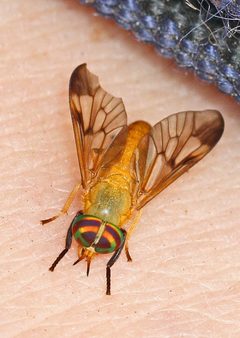
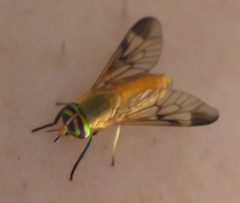
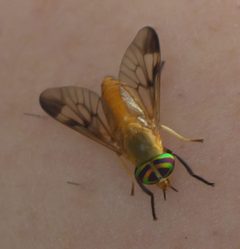
Distinguished from other horse flies by its yellow body coloration combined with black fore-legs and yellow mid- and hind-legs. The blue-green with purple bands are diagnostic. Its silent and aggressive human-biting separate it from less aggressive tabanids. The specific epithet 'ferrugatus' (rusty) refers to its coloration.
Images
Appearance
are approximately 10 mm in length with predominantly yellow bodies. The mid-legs and hind-legs are yellow, while the fore-legs are black. The are blue-green with distinctive purple bands. The flies with minimal sound, making it difficult to detect before biting. Larvae are thin white covered with fine yellow fur, with each body segment bearing three pairs of pseudopodia.
Habitat
Found most commonly near bodies of water with adjacent tree cover. Frequently shelters in Spanish moss (Tillandsia usneoides) and other vegetation. The combination of aquatic breeding sites and nearby resting cover is essential for persistence.
Distribution
Native to North and Central America. In the United States, occurs from New Jersey south to Texas, with highest abundance in the southeastern coastal plain. Range extends through Mexico and Central America to Rica.
Seasonality
Most active during summer and early autumn. Peak abundance in June in northwestern Florida. -seeking activity occurs during daylight hours, with primary peak at sunset (approximately 1945h CST) and a secondary minor peak at midday (approximately 1145h). No activity occurs after darkness.
Diet
females feed on blood, including human blood, to develop . Adult males and females have been observed feeding on fructose; approximately 72% of adults collected in one study had fed on fructose. Larval diet unknown from sources.
Host Associations
- Homo sapiens - blood primary human pest; aggressive biter
- Tillandsia usneoides - shelterresting site for
Life Cycle
Complete with , larval, pupal, and stages. Larvae are aquatic or semi-aquatic white with fine yellow fur and pseudopodia on each segment. Approximately 96.9% of -seeking adults are nulliparous (have not yet reproduced), suggesting most occurs before first . Mark-recapture studies indicate most individuals are transitory and do not remain in capture areas.
Behavior
Exhibits highly aggressive -seeking toward humans. Flies silently, making detection difficult before biting. Will enter buildings in pursuit of hosts. Mark-recapture data show individuals are transitory rather than resident. Host-seeking is temperature-dependent; ceases after darkness.
Ecological Role
females function as blood-feeding of vertebrates. Fructose feeding suggests adult pollination or plant association. Larval poorly documented. characterized by transitory adult movements.
Human Relevance
Significant pest affecting outdoor recreation including swimming, boating, and fishing, particularly April through June in affected regions. Bites produce painful, itchy welts. DEET-based repellents provide partial protection; physical barriers (gloves, headnets) are most effective when flies are abundant. Considered the most aggressive fly species in Florida.
Similar Taxa
- Chrysops spp.Formerly classified in same (Chrysops ferrugatus); share Tabanidae and biting habit but distinguished by yellow fly's distinctive color pattern and more aggressive
- Other Tabanus spp.Share and general horse fly ; distinguished by Diachlorus ferrugatus's smaller size, yellow coloration, and notably aggressive human-directed
More Details
Original description
Originally described as Chrysops ferrugatus by Johan Christian Fabricius in 1805, later transferred to Diachlorus.
Sugar feeding
Anthrone assays indicate approximately 72% of had fed on fructose, suggesting plant-derived sugar is an important adult energy source.
Reproductive status of host-seekers
Parity assays showed 96.9% of -seeking were nulliparous, indicating most biting activity occurs before first .