
Chlorotabanus crepuscularis
(Bequaert, 1926)
Green Horse Fly
Chlorotabanus crepuscularis is the only green tabanid horse fly in North America. It is a blood-feeding active primarily at night, with females using carbon dioxide sensing to locate mammalian . The species has been recorded from Texas to Delaware, with peak activity in Florida occurring from May to mid-July. Larvae are and develop in moist soil and aquatic edge .
Pronunciation
How to pronounce Chlorotabanus crepuscularis: /kloʊroʊtəˈbeɪnəs krɛpəˈskjʊlərɪs/
These audio files are automatically generated. While they are not always 100% accurate, they are a good starting point.
Identification
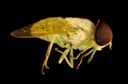
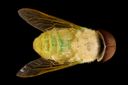
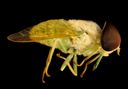
The bright green body coloration is unique among North American Tabanidae and immediately diagnostic. fluorescence under UV light (385 nm) provides an additional verification method. No other North American horse fly shares the green coloration.
Images
Appearance
are bright green in coloration, distinguishing this from all other North American tabanids. are brown in natural light but fluoresce yellow under 385 nm ultraviolet light. (blood) is blue.
Habitat
are found in areas where mammalian are present. Larvae inhabit soil adjacent to water, floating vegetation, and forest sand in moist environments.
Distribution
Eastern United States from Texas to Delaware. Records from Florida document presence.
Seasonality
active March through September in Florida, with peak activity from May to mid-July. Activity pattern is to .
Diet
Females are sanguinivorous, feeding on mammalian blood. Larvae are .
Life Cycle
Larvae develop in moist soil near water, on floating vegetation, or in forest sand. Specific details of and pupal stages are not documented in available sources.
Behavior
Females are nocturnally active and possess carbon dioxide sensing ability to locate mammalian . Peak activity occurs during evening hours.
Ecological Role
females function as of mammals. Larvae are , likely contributing to soil and aquatic edge dynamics.
Human Relevance
Blood-feeding females may bite humans and other mammals, potentially serving as nuisance pests. The unique green coloration and UV fluorescence properties may be of interest to researchers and collectors.
More Details
Taxonomic History
Tabanus tetrapunctus Thunberg, 1827 was synonymized with C. crepuscularis in the 2010 taxonomic revision by Wilkerson and Fairchild.