
Chrysops callidus
Osten Sacken, 1875
Beautiful Deer Fly
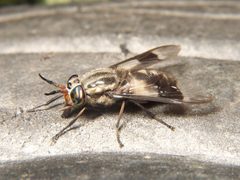
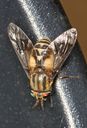
Chrysops callidus is a of deer fly in the Tabanidae, first described by Osten Sacken in 1875. Commonly known as the Beautiful Deer Fly, this species is distributed across Canada and the United States. Females possess a specialized food canal with twelve pairs of putative sensory trichites that monitor blood flow during feeding. The species serves as an intermediate for the haemosporidian Haemoproteus metchnikovi, with documented sporogonic development occurring in the fly's epithelium.
Pronunciation
How to pronounce Chrysops callidus: /ˈkrɪsɒps ˈkalɪdəs/
These audio files are automatically generated. While they are not always 100% accurate, they are a good starting point.
Images
Distribution
Canada and the United States. Specific records include Vermont.
Diet
Blood-feeding (females only, inferred from presence of sensory trichites in the food canal specialized for monitoring blood flow).
Host Associations
- Haemoproteus metchnikovi - intermediate Sporogonic stages of this haemosporidian develop in the epithelium; young oocysts form beneath the and protrude into the haemocoel space.
Human Relevance
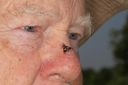
Potential for Haemoproteus metchnikovi, a haemosporidian . Deer flies in general are known biting pests, though specific medical or veterinary significance of C. callidus is not documented in available sources.
Sources and further reading
- BugGuide
- Wikipedia
- GBIF taxonomy match
- iNaturalist taxon
- Catalogue of Life
- Grasshoppers of Colorado
- Publications | Entomology Research Museum
- Striped Sand Grasshopper
- Names Matter | Bug Squad
- Bug Eric: What the Insects Have Taught Me
- Bug Eric: May 2020
- Sensory trichites associated with the food canal of Chrysops callidus (Diptera: Tabanidae).
- Sensory Trichites Associated With the Food Canal ofChrysops callidus(Diptera: Tabanidae)
- Fine Structure of Differentiating Oocysts and Mature Sporozoites of Haemoproteus metchnikovi in its Intermediate Host Chrysops callidus*