
Chrysopilus thoracicus
(Fabricius, 1805)
Golden-backed Snipe Fly
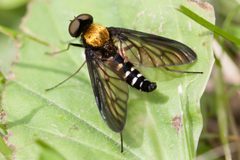
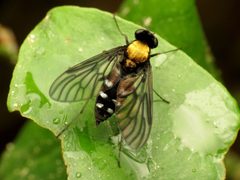
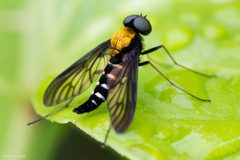
Chrysopilus thoracicus, commonly known as the golden-backed snipe fly, is a of snipe fly in the Rhagionidae. It is typically found in woodland of eastern North America. The species is distinguished by its golden or yellowish coloration on the , which gives rise to its . are most commonly observed during late spring and early summer months.
Pronunciation
How to pronounce Chrysopilus thoracicus: /ˈkrɪsɒpɪˌlʊs θɔˈræsɪkəs/
These audio files are automatically generated. While they are not always 100% accurate, they are a good starting point.
Identification
The golden-backed snipe fly is recognized by the distinctive golden or yellowish coloration on the , which contrasts with the darker . Males have that meet at the top of the , while females have eyes that are separated. Body length is moderate for the . The wings are clear with typical dipteran venation. The may be confused with other Chrysopilus species, but the golden thoracic coloration is diagnostic.
Images
Habitat
Woodland areas, particularly in the eastern part of North America. Specific microhabitat details such as moisture preferences or understory associations are not well documented in available sources.
Distribution
Eastern North America, including the United States and Canada. Records exist from Vermont and other eastern states. The western limits of its range are not clearly defined in available sources.
Seasonality
have been observed primarily in late spring and early summer (May through July), with peak activity likely in June. Specific phenological data beyond this general pattern is not available.
Behavior
are typically found resting on foliage in woodland understories. Males are known to have in contact at the top of the , suggesting visual-based mate location or territorial , though specific behavioral observations are limited.
Ecological Role
As a member of the Rhagionidae, the likely functions as a in larval stages, though this has not been directly documented for C. thoracicus specifically. may serve as minor if they visit flowers, though this is not confirmed.
Human Relevance
The is of no direct economic importance. It is occasionally encountered by naturalists and entomologists in woodland settings. It poses no known medical or agricultural threat.
Similar Taxa
- Chrysopilus ornatus snipe fly shares the same and general body plan, but C. ornatus has metallic covering the body and lacks the distinctive solid golden of C. thoracicus. C. ornatus also has a broader distribution across the northeastern U.S. and adjacent Canada.
- Other RhagionidaeOther snipe flies in the share general body form and wing venation, but differ in coloration patterns; most lack the conspicuous golden thoracic coloration that characterizes C. thoracicus.
Sources and further reading
- BugGuide
- Wikipedia
- GBIF taxonomy match
- iNaturalist taxon
- NCBI Taxonomy
- Catalogue of Life
- Retrachydes thoracicus – times four! | Beetles In The Bush
- Boisterous bee-havior of ground nesting bees, Colletes thoracicus — Bug of the Week
- Bug Eric: January 2014
- Spring sunshine heralds the appearance of plasterer bees: Colletes — Bug of the Week
- Spring arrives and with it, delightful Plasterer bees: Colletes spp. — Bug of the Week
- Bug of the Week