
Chrysopilus basilaris
(Say, 1823)
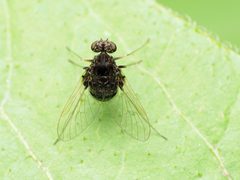
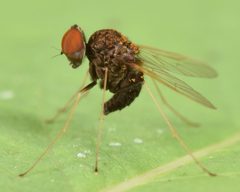
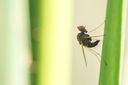
Chrysopilus basilaris is a of snipe fly in the Rhagionidae. It is found in the United States. Like other members of the Chrysopilus, are likely characterized by metallic scaling on the . The species was first described by Thomas Say in 1823.
Pronunciation
How to pronounce Chrysopilus basilaris: /ˈkrɪsɔpɪləs ˌbæsəˈlɛərɪs/
These audio files are automatically generated. While they are not always 100% accurate, they are a good starting point.
Identification
May be distinguished from related by features of the and . The specific epithet "basilaris" suggests a characteristic marking or structure at the base of a body part. Accurate identification to species level typically requires examination of morphological details not readily visible in field observations.
Images
Distribution
United States. Specific state-level distribution records are not documented in available sources.
Similar Taxa
- Chrysopilus ornatusSimilar snipe fly with metallic scaling; C. ornatus occurs in northeastern U.S. and adjacent southern Canada, potentially overlapping in range with C. basilaris. C. ornatus males have in contact at the top of the , females with eyes separated; body length 8-10 mm.
- Other Chrysopilus speciesMembers of this share metallic scaling and general snipe fly . -level identification requires detailed morphological examination.
More Details
Taxonomic Note
The specific epithet "basilaris" refers to a basal feature, likely a marking or structural characteristic. The has been documented in 798 iNaturalist observations as of the data cutoff, suggesting it is not uncommon where it occurs.