
Eupeodes latifasciatus
(Macquart, 1829)
Broad-banded Aphideater, meadow field syrph
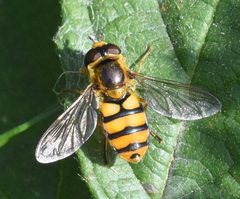
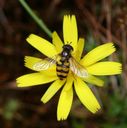
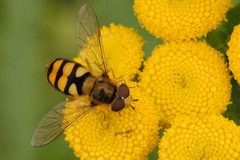
Eupeodes latifasciatus is a small hoverfly with wing length 6.5–8.5 mm, distinguished by yellow markings into bands on abdominal segments three and four. feed on nectar from diverse flowers and serve as . Larvae are , feeding on aphids and scale insects (Hemiptera). The has a broad distribution across the Palaearctic and Nearctic regions, with activity primarily from May to September.
Pronunciation
How to pronounce Eupeodes latifasciatus: /juːˈpiːoʊdiːz ˌlæ.tɪ.fæs.siˈeɪ.təs/
These audio files are automatically generated. While they are not always 100% accurate, they are a good starting point.
Identification
Distinguished from similar Eupeodes , particularly E. corollae, by yellow markings into bands on abdominal segments three and four that reach the lateral margins. Male with straight, parallel margins of yellow spots; female with entirely shiny lacking dust spots and yellow lateral margins on tergite 5.
Images
Habitat
Wetland and open ground including fens, humid grassland, stream margins in open country, and unsown land. Prefers lush vegetation and damp meadows over garden environments.
Distribution
Palaearctic: Fennoscandia south to Iberia and Mediterranean basin, Turkey, Ireland east through Europe to European Russia, Russian Far East, Siberia to Pacific coast (Sakhalin, Kuril Islands), India. Nearctic: Alaska south to California and Texas. Widespread in UK, more frequent in southern regions.
Seasonality
period May to September; April to October in southern Europe.
Diet
feed on nectar. Larvae are predatory, feeding on aphids and scale insects (Hemiptera).
Host Associations
- Hemiptera - Larvae feed on aphids and scale insects
Life Cycle
Females lay in or near colonies. Larvae pass through three instars before . Pupa is a convex pear-shaped structure attached to leaves, stems, or other substrates. emerge from the pupal case. Specific timing of developmental stages not documented.
Behavior
hover near flowers and visit blossoms for nectar. Females oviposit in proximity to colonies. Larvae are cryptic, often resembling discolored leaf patches.
Ecological Role
function as of various flowering plants. Larvae serve as agents of and insect .
Human Relevance
Beneficial insect in gardens and agricultural settings due to larval on pests. contribute to pollination. Frequently mistaken for bees or due to mimicry, which may confer protection from .
Similar Taxa
- Eupeodes corollaeSimilar abdominal patterning, but E. latifasciatus has yellow markings into bands reaching lateral margins on tergites 3–4, whereas E. corollae has more separated spots.
Misconceptions
Larvae are often mistaken for plant-feeding caterpillars or foliage pests and may be inadvertently destroyed during control efforts. are frequently mistaken for bees or due to protective mimicry.
More Details
Flowers visited
White umbellifers, Caltha, Convolvulus, Euphorbia, Prunus padus, Ranunculus, Salix repens, Taraxacum, Tussilago, Ulex.
Genome
sequenced from female specimen collected in Wytham Woods, UK: 846 Mb span, 96.8% scaffolded into 4 chromosomal pseudomolecules (3 + X ), complete mitochondrial genome 18.5 kb, 12,848 protein-coding genes annotated.