
Platycheirus trichopus
(Thomson, 1869)
Western Forest Sedgesitter
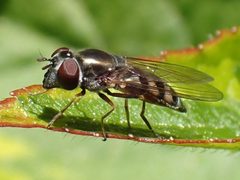
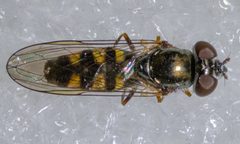
Platycheirus trichopus, commonly known as the western forest sedgesitter, is a syrphid fly in the tribe Bacchini. Unlike most Platycheirus , which require microscopic examination for identification, this species possesses distinctive characteristics visible in high-quality images of the and . It is primarily distributed west of the Rocky Mountains in North America.
Pronunciation
How to pronounce Platycheirus trichopus: //ˌplætɪˈkaɪrəs ˈtrɪkoʊpəs//
These audio files are automatically generated. While they are not always 100% accurate, they are a good starting point.
Identification
Most Platycheirus cannot be identified past without microscopic examination. However, P. trichopus is an exception: high-quality images of the and reveal a unique set of characteristics that allow species-level identification, according to Even Dankowicz. Specific diagnostic features of the head/face are not detailed in available sources.
Images
Habitat
Associated with forested environments, as indicated by the "western forest sedgesitter." Specific microhabitat requirements are not documented.
Distribution
Found west of the Rocky Mountains in North America. The has been documented in California, with photographic records from the UC Davis Stebbins Cold Canyon Reserve.
Seasonality
have been observed in April in California. Broader seasonal patterns are not documented.
Behavior
have been observed nectaring on flowers, including rock purslane (Calandrinia grandiflora).
Human Relevance
A male specimen was featured in the 2018 Entomological Society of America "World of Insects" calendar, selected from 560 entries submitted by 133 photographers. The image was captured by UC Davis alumnus Alexander Nguyen at the UC Davis Stebbins Cold Canyon Reserve in April 2017.
Similar Taxa
- Other Platycheirus speciesMost congeneric require microscopic examination for identification, whereas P. trichopus can be identified from high-quality / images.
More Details
Taxonomic Note
Originally described as Syrphus trichopus by Thomson in 1869, later transferred to Platycheirus.
Sources and further reading
- BugGuide
- Wikipedia
- GBIF taxonomy match
- iNaturalist taxon
- NCBI Taxonomy
- Catalogue of Life
- Inside the 'World of Insects' Calendar | Bug Squad
- Celebrating National Moth Night at the Bohart Museum of Entomology | Bug Squad
- Ready for Moth Night at UC Davis? | Bug Squad
- Bohart Museum Open House: Let's Celebrate Moths! | Bug Squad
- Bug Squad
- Hovering | Bug Squad