
Teuchocnemis bacuntius
(Walker, 1849)
Orange Spur Fly
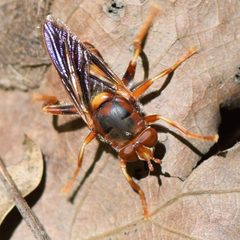
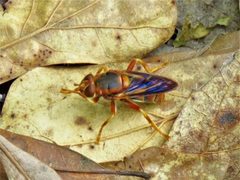
Teuchocnemis bacuntius is a rare of syrphid fly in the Syrphidae, commonly known as the Orange Spur Fly. are medium-sized hoverflies distinguished by orange coloration and sexually dimorphic leg modifications. The species has been documented in the eastern United States with historical records from Georgia and Texas, though it remains poorly known with larvae undescribed.
Pronunciation
How to pronounce Teuchocnemis bacuntius: /ˌtɛʊkoʊˈknɛmɪs bəˈkʌnti.əs/
These audio files are automatically generated. While they are not always 100% accurate, they are a good starting point.
Identification
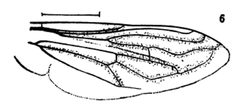
Distinguished from other Teuchocnemis and syrphid flies by the combination of orange body color, swollen hind , and the male's hind tibial spur. The specific leg modifications separate it from . Size range and coloration may help distinguish it from other orange-colored hoverflies in the eastern United States.
Images
Appearance
measure 13.5–18.1 mm in length. Body coloration is orange. Hind is swollen. Males possess a distinct spur on the hind tibia.
Distribution
Eastern half of the United States. Historical records from Georgia and Texas (1887).
Life Cycle
Larvae unknown. stage only described.
Similar Taxa
- Other Teuchocnemis speciesMay share general body plan and coloration; distinguished by specific leg modifications (swollen hind , male tibial spur) and size range.
- Other orange-colored SyrphidaeSimilar coloration in eastern US hoverflies; separated by structural characters of the hind legs and body proportions.
More Details
Taxonomic history
Described by Walker in 1849. The remains rare in collections with limited modern documentation despite 167 iNaturalist observations.
Larval biology
Larvae have never been described, and the and remain completely unknown—a significant gap in the ' natural history.