
Temnostoma trifasciatum
(Robertson, 1901)
Three-lined Falsehorn
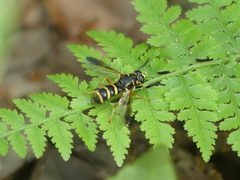
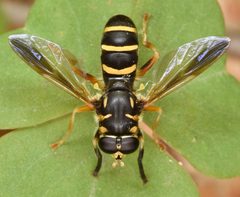
Temnostoma trifasciatum is a rare of syrphid fly found in eastern and central North America. are strong mimics of solitary mason wasps (Eumeninae), exhibiting sophisticated behavioral and morphological mimicry. The species is associated with woodland where larvae develop in moist decayed wood. Adults visit flowers for nectar and pollen.
Pronunciation
How to pronounce Temnostoma trifasciatum: /tɛm.nost.oʊ.ma trɪ.fas.siˈeɪ.təm/
These audio files are automatically generated. While they are not always 100% accurate, they are a good starting point.
Identification
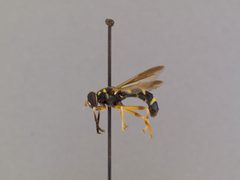
Distinguished from other Temnostoma by the three-lined pattern referenced in the , though specific diagnostic features require specimen examination. Separated from true by single pair of wings (Diptera), short , and leg-waving . Distinguished from the related Sphecomyia by shorter, less robust antennae and different pattern. Identification to species level typically requires microscopic examination due to similarity among Temnostoma species.
Images
Habitat
Woodland edges and forested areas with moist decayed wood available for larval development. have been observed near woodland edges with flowering vegetation.
Distribution
Eastern and central United States; recorded from Canada. Specific range details limited by rarity of observations.
Seasonality
active during spring and summer; one observation record from mid-May in Illinois.
Diet
feed on nectar and pollen from flowers. Larval diet unknown but presumed to involve decaying wood substrates.
Life Cycle
Larvae burrow in moist decayed wood. Complete developmental details and site unknown.
Behavior
perform conspicuous leg-waving , holding the front pair of legs in front of the to simulate . Capable of nearly motionless hovering typical of Syrphidae. Strong flight ability allows extended hovering near flowers.
Ecological Role
contribute to pollination through flower visitation. Larvae contribute to wood decomposition processes in forest . Mimicry of stinging likely reduces pressure.
Human Relevance
No documented economic or medical significance. Rarity of the limits human encounters.
Similar Taxa
- Sphecomyia vittataBoth are syrphid mimics, but Sphecomyia has longer, thicker more closely resembling yellowjacket antennae, and exhibits lazy zig-zag unlike Temnostoma.
- Temnostoma alternans and other Temnostoma speciesCongeneric share -mimetic and leg-waving ; species-level identification requires detailed examination.
- Ancistrocerus and other eumenine waspsModel for Temnostoma mimicry; distinguished by two pairs of wings, longer , and different resting posture.
More Details
Mimicry sophistication
Temnostoma flies exhibit among the most elaborate mimicry in Syrphidae, including behavioral compensation for morphological differences from models (leg-waving to simulate ) and wing margin darkening to simulate wing folding.
Rarity
Only 60 observations recorded on iNaturalist as of data compilation, indicating the is genuinely uncommon or underdetected.