
Anasimyia distincta
short-spurred swamp fly
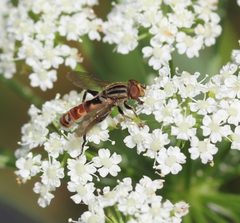
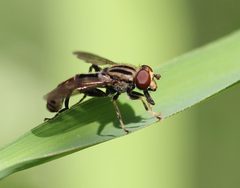
Anasimyia distincta, known as the short-spurred swamp fly, is a rare syrphid fly documented in the northeastern United States and adjacent Canada. are commonly observed on flowers where they feed on nectar and pollen. The species belongs to a whose larvae are aquatic and possess the characteristic rat-tailed of eristaline hoverflies.
Pronunciation
How to pronounce Anasimyia distincta: /ˌænəsɪˈmaɪə dɪˈstɪŋktə/
These audio files are automatically generated. While they are not always 100% accurate, they are a good starting point.
Identification
The 'short-spurred swamp fly' refers to a presumably shortened spur on the hind tibia, though specific diagnostic features distinguishing this from are not detailed in available sources. As a member of Anasimyia, it likely exhibits the metallic coloration typical of the , but species-level identification requires examination of male genitalia or other subtle morphological characters.
Images
Habitat
Aquatic or semi-aquatic environments associated with wetlands, swamps, or standing water where rat-tailed larvae develop. frequent flowering vegetation in or near these wetland .
Distribution
Northeastern United States and adjacent Canada. Documented as rare with limited occurrence records.
Diet
feed on nectar and pollen from flowers. Larval diet unknown specifically for this ; related Anasimyia larvae are aquatic or in decaying organic matter.
Life Cycle
Complete with aquatic larval stage. Larvae possess a telescoping respiratory siphon (rat-tail) that extends to the water surface for breathing. Specific developmental timing and site unknown for this .
Behavior
exhibit typical hoverfly , capable of remaining nearly motionless in flight. Has been observed visiting flowers for feeding.
Ecological Role
may contribute to pollination of flowering plants. Aquatic larvae likely participate in nutrient cycling in wetland through detritus processing.
Human Relevance
No documented economic or medical significance. Rarity and limited distribution may make it of interest to conservation monitoring.
Similar Taxa
- Other Anasimyia speciesShare metallic coloration, wetland associations, and rat-tailed larval . Require examination of genitalia or other fine structural characters for definitive separation.
- Parhelophilus speciesAnother of metallic eristaline hoverflies with similar appearance and aquatic larvae; distinguished by subtle differences in wing venation and male genitalia.
More Details
Genus-level larval biology
While specific larval of A. distincta is unrecorded, Anasimyia larvae generally inhabit shallow aquatic or semi-aquatic environments with decaying vegetation and organic detritus. The rat-tailed respiratory siphon allows larvae to breathe while buried in substrate.
Sources and further reading
- BugGuide
- Wikipedia
- Like a Moth to a Flame: Moth Night at Bohart Museum of Entomology | Bug Squad
- Meloidae Holdings | Entomology Research Museum
- Bohart Museum of Entomology: One Busy Place! | Bug Squad
- Scarab Beetles First to Arrive at UC Davis 'Moth Night' | Bug Squad
- Bug Eric: City Nature Challenge 2024 Recap
- Bug Eric: First Night of Blacklighting