
Eristalis dimidiata
(Wiedemann, 1830)
Black-shouldered Drone Fly
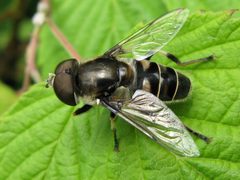
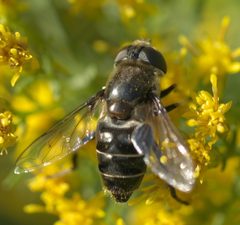
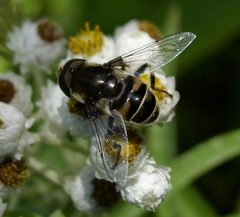
A hoverfly found in forested regions of North America, recognized by its distinctive wing pattern with dark humeral and mostly transparent wings. are among the earliest hoverflies active in spring and likely overwinter as adults. Larvae develop as aquatic filter-feeders with rat-tailed .
Pronunciation
How to pronounce Eristalis dimidiata: /ɛrɪˈstalɪs daɪmɪˈdɪɑːtə/
These audio files are automatically generated. While they are not always 100% accurate, they are a good starting point.
Identification
Images
Appearance
Medium-sized hoverfly with predominantly black body and white margins on abdominal segments. Wings distinctive: humeral at wing base opaque and infuscated (darkened), remainder of wing hyaline (transparent), sometimes with diffuse medial spot. Hind entirely black. Pterostigma dark brown and distinct. with 1–6 short bristles.
Habitat
Primarily forested environments.
Distribution
Native to much of Canada and the eastern and northern United States.
Seasonality
Active year-round in southern parts of range; from late March to mid-November in northern areas. One of the earliest hoverflies to appear in spring.
Diet
feed on nectar and pollen from flowers. Larvae are aquatic filter-feeders.
Life Cycle
Likely overwinters as . Aquatic larval stage with rat-tailed typical of Eristalis.
Behavior
hover motionless in , characteristic of hoverflies. Frequently observed visiting flowers.
Ecological Role
contribute to pollination through flower visitation. Aquatic larvae participate in detritus processing in freshwater systems.
Similar Taxa
- Other Eristalis speciesShare general body plan and hoverfly ; distinguished by wing pattern (humeral entirely dark) and black hind
- Syrphus and other hoverfly generaSimilar flower-visiting and appearance; require examination of wing venation and leg coloration for separation