
Neoascia tenur
(Harris, 1780)
Black-kneed Fen Fly
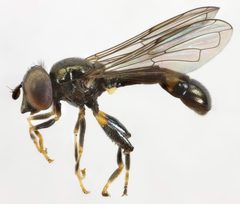
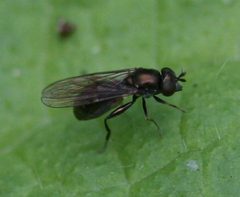
Neoascia tenur is a small Palearctic hoverfly in the Syrphidae, commonly known as the Black-kneed Fen Fly. The is strongly associated with wetland across northern and central Europe, extending into Siberia. are active from spring through early autumn and visit flowers of wetland plants. The larvae develop sub-aquatically within the stem of emergent aquatic vegetation such as cattails (Typha).
Pronunciation
How to pronounce Neoascia tenur: /niːoʊˈæs.i.ə ˈtɛn.jʊr/
These audio files are automatically generated. While they are not always 100% accurate, they are a good starting point.
Identification
Distinguished from similar Neoascia by the combination of: fore tibia yellow with dark ring, fore yellow with dark patch (not entirely dark), and relatively narrow in females compared to N. meticulosa. Male genitalia require examination for definitive identification; see Barkemeyer & Claussen (1986) and Maibach & Goeldlin (1993) for diagnostic illustrations. The small size and wetland association help separate it from larger syrphid .
Images
Appearance
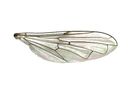
Small hoverfly with wing length 3.25–5 mm. Fore tibia yellow with a dark ring. Fore yellow with a dark patch, remaining tarsal segments yellowish. Females have a relatively narrow compared to the broader abdomen of N. meticulosa.
Habitat
Wetlands including flushes and streams in blanket bog, raised bogs, fens, wet grassland, pond and lake margins, and along brooks. Strongly associated with standing or slow-moving water with emergent vegetation.
Distribution
Palearctic: Fennoscandia south to Iberia and the Mediterranean basin; Ireland east through Europe into Turkey, European Russia, and Siberia. Presence confirmed in Belgium (Flanders, Brussels-Capital Region, Walloon Region).
Seasonality
period April to September.
Diet
visit flowers including Caltha, Cicuta virosa, Filipendula ulmaria, Potentilla erecta, Ranunculus, and Salix repens. Larval diet unknown; larvae develop within aquatic plant stems.
Life Cycle
Larva is sub-aquatic, developing within stem of Typha and other water plants. Larvae and described and figured by Maibach and Goeldlin (1993).
Behavior
are flower visitors in wetland . Larvae inhabit submerged portions of emergent aquatic plants.
Ecological Role
may contribute to pollination of wetland flowers. Larval role within aquatic plant not documented.
Similar Taxa
- Neoascia meticulosaFemales have a broader than N. tenur; leg coloration patterns differ
- Other Neoascia speciesRequire examination of male genitalia and leg coloration patterns for separation
More Details
Taxonomic history
Described by Harris in 1780; male genitalia illustrated by Barkemeyer & Claussen (1986); larval and puparial detailed by Maibach & Goeldlin (1993)
Sources and further reading
- BugGuide
- Wikipedia
- GBIF taxonomy match
- iNaturalist taxon
- NCBI Taxonomy
- A Special Day for UC Davis Distinguished Professor Walter Leal | Bug Squad
- Distinguished Service, Distinguished Awards | Bug Squad
- Our IPM Expert | Bug Squad
- UC Davis Faculty Award Recipients to Be Celebrated May 13 | Bug Squad
- A Female Entomologist's Perspective on Science and the Tenure System
- A Year Older, A Year Wiser: 5 More Things I've Learned About a Career in Extension