
Sargus bipunctatus
(Scopoli, 1763)
twin-spot centurion, Twin-Spot Centurion Fly
Sargus bipunctatus, commonly known as the twin-spot centurion, is a European soldier fly in the Stratiomyidae. range from 10–14 mm in body length and display in coloration. The is associated with decaying organic matter, where females oviposit and larvae develop. It has been observed in both open and wooded from July through November.
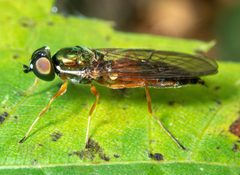
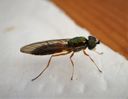
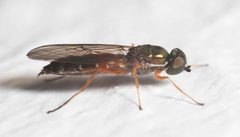
Identification
Distinguished from the similar Sargus cuprarius by a narrower . Males are slender with a metallic green and brown with violet metallic tinge; females are broader with the abdomen base extensively reddish and a blackish tip bearing blue reflections. Wings are slightly yellow. Legs are red with brown at the apex. Body length 10–14 mm.
Images
Habitat
Found in open and wooded . frequently sunbathe on foliage in sheltered spots.
Distribution
Europe, including Belgium, Denmark, and southern Western Europe; also recorded in the Trans-Caucasus Central belt.
Seasonality
period from July to November.
Life Cycle
Females lay on fresh , manure, or in nearby soil. Larvae develop in cow dung, compost, rotting vegetation, and decaying fungi. Larvae have also been found in egg pods of the locust .
Behavior
sunbathe on foliage in sheltered locations.
Ecological Role
Larvae contribute to decomposition of organic matter including , compost, and rotting vegetation.
Similar Taxa
- Sargus cuprariusSimilar appearance but with broader ; S. bipunctatus has narrower frons and distinct abdominal coloration differences between sexes.