
Beris
Latreille, 1802
false soldier fly
Species Guides
1- Beris fuscipes(Short-horned Black Legionnaire)
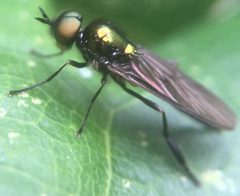
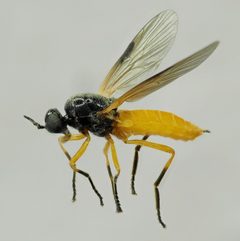
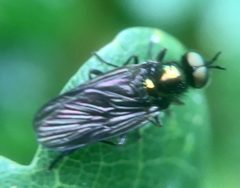
Beris is a of soldier flies ( Stratiomyidae) described by Latreille in 1802. These small to medium-sized flies are characterized by metallic coloration and elongated bodies. The genus is distinguished by reduced palpi, a scutellum bearing spines, and seven visible abdominal segments. are often found near larval and may form swarms around foliage in damp environments.
Pronunciation
How to pronounce Beris: /ˈbɛrɪs/
These audio files are automatically generated. While they are not always 100% accurate, they are a good starting point.
Identification
Distinguished from other Stratiomyidae by combination of: reduced palpi; scutellum with spines; seven visible abdominal segments; metallic green or black with contrasting orange or black . The wing venation with interior and small in half is diagnostic for level. Males identified by smaller size and contiguous . Some resemble or bees due to bright metallic coloration.
Images
Habitat
frequent flowers and form swarms around foliage near mountain valleys, marshes, and damp places. Larval include decaying organic matter, wet moss, compost, and aquatic environments. Primarily found in tropical regions but with global distribution including temperate zones.
Distribution
Global distribution with concentration in tropical regions. Documented from Europe (Denmark, Norway, Sweden), North America (Vermont, United States), and Asia. The contains approximately 50 described with varying regional ranges.
Seasonality
In temperate regions, active during period; larvae may hibernate multiple times. Specific adult periods vary by and latitude.
Diet
Larvae feed on detritus using specialized mouthparts as sweeping apparatus; aquatic larvae consume decaying leaves, micro-organisms, and detritus. with elongated and narrow are nectar feeders; those with short proboscis and large fleshy labella consume pollen grains and honeydew.
Life Cycle
in temperate regions. Female lays 600 or more pale yellow elongated per batch. Larvae undergo development with potential for multiple hibernation periods. occurs within final larval skin (); pupa smaller than puparium with air-filled space for flotation on water surface. Terrestrial larvae are elongated and oval with rounded abdominal end; aquatic or semi-aquatic larvae have tapering end with crown of hydrofuge hairs.
Behavior
form swarms, typically observed around foliage near mountain valleys, marshes, and damp places. Adults frequent flowers. Larvae are not predatory or parasitic.
Ecological Role
Larvae function as scavengers in decaying organic matter and aquatic detritus systems, contributing to nutrient cycling. may serve as when feeding on nectar or pollen.
Similar Taxa
More Details
Larval morphology
Larval body flat with strongly sclerotized capsule, three thoracic and approximately eight abdominal segments. has honeycomb-like appearance due to calcium carbonate secretions. and into two mandibular-maxillary complexes that move alternately in vertical plane.