
Themira
Robineau-Desvoidy, 1830
Species Guides
3- Themira annulipes
- Themira lohmanus(Lohman's ensign-fly)
- Themira nigricornis(black scavenger fly)
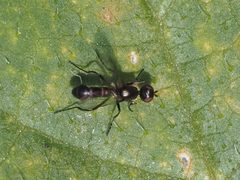
Themira is a of small flies in the Sepsidae, containing approximately 17 described distributed across the Holarctic region. Members of this genus are necrophagous and , commonly associated with decomposing animal matter and . The genus is considered relatively basal within Sepsidae and exhibits complex male courtship involving specialized morphological structures. Several species show wide geographic distributions, including disjunct and records in urban environments.
Pronunciation
How to pronounce Themira: //θɛˈmiːrə//
These audio files are automatically generated. While they are not always 100% accurate, they are a good starting point.
Identification
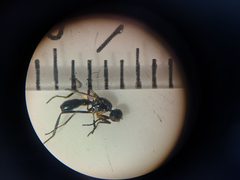
Themira are distinguished from other sepsid by male genitalic structures, particularly the form and coloration of the 4th sternites and the mobile surstyli. Males possess forelegs used during courtship to grasp the base of the female's wing. Species-level identification requires examination of male terminalia and sternal lobe . of the COI mitochondrial gene has been used to confirm species identity in taxonomic studies.
Images
Habitat
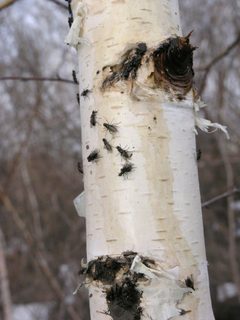
occur in diverse environments including urban parks, forested areas, and open landscapes. Specific documented include urban settings with arboreal vegetation and rich ground cover of small plants and shrubs. Some species have been collected from experimental carrion placements on soil ground surrounded by vegetation.
Distribution
Primarily Holarctic distribution with records across Europe, Asia, and North America. European records include Austria, Great Britain, Czech Republic, Denmark, Finland, France, Germany, Hungary, Latvia, Lithuania, Norway, Poland, Russia, Slovakia, Sweden, Switzerland, Netherlands, Ukraine, Italy, and Romania. Nearctic distribution includes USA (Alaska, Connecticut, Illinois, Maryland, Massachusetts, New Hampshire, New Jersey, New York, Pennsylvania) and Canada (Newfoundland). Palaearctic Asia includes Kazakhstan, Korea, Kyrgyzstan, Pakistan, Turkmenistan, South Korea, and Japan. Disjunct Neotropical record in Cuba documented for T. leachi.
Seasonality
active during warm season, with main occurrence from late March through August. T. nigricornis has been collected in the second half of April at temperatures around 20°C.
Diet
Necrophagous; feeds on decomposing animal material. T. nigricornis has been observed on pig carcass in advanced decomposition stage. Sepsidae is known as black scavenger flies with preference, found on , animal and plant decaying material, and predominantly on human and animal excrements.
Behavior
Males exhibit elaborate courtship involving at least five distinct patterns, with at least three shared with more derived sepsid groups. During copulation, male sternal lobes twist and separate to fan out combs of long setae that tap the female. Male genitalic surstyli are mobile and likely serve to clasp the female. Males use forelegs to hold onto the base of the female wing during mounting. Some show relatively low abundance, with only occasional peaks.
Ecological Role
Contributes to decomposition of faeces and carrion. Necrophagous aid in carcass decomposition processes. Frequently occurs simultaneously with other necrophagous including Calliphoridae, Muscidae, Cleridae, and Silphidae.
Human Relevance
Occurs in urban park environments. Used as in due to association with carrion. Subject of behavioral and evolutionary studies examining the origin of complex courtship in sepsid flies.
Similar Taxa
- Other Sepsidae generaThemira is distinguished by relatively basal phylogenetic position and presence of mobile genitalic surstyli and elaborate sternal lobe courtship structures that differ from derived sepsid
More Details
Taxonomic note
The Themira is considered relatively basal within Sepsidae, making it important for understanding the evolutionary origins of complex courtship in the . T. lohmanus was described in 2017 from urban parks in New York City based on , sequences, mating behavior, and reproductive isolation.
Sources and further reading
- BugGuide
- Wikipedia
- GBIF taxonomy match
- iNaturalist taxon
- NCBI Taxonomy
- Catalogue of Life
- First Record of Themira Nigricornis (Meigen, 1826) (Sepsidae: Diptera) in Romania/ Prima semnalare a speciei Themira Nigricornis (Meigen, 1826) (Sepsidae: Diptera) în România
- Morphology and DNA sequences confirm the first Neotropical record for the Holarctic sepsid species Themira leachi (Meigen) (Diptera: Sepsidae)
- Sexual behavior and morphology of Themira minor (Diptera: Sepsidae) males and the evolution of male sternal lobes and genitalic surstyli
- Hidden in the urban parks of New York City: Themira lohmanus, a new species of Sepsidae described based on morphology, DNA sequences, mating behavior, and reproductive isolation (Sepsidae, Diptera)
- Figure 3 from: Ang Y, Rajaratnam G, Su KFY, Meier R (2017) Hidden in the urban parks of New York City: Themira lohmanus, a new species of Sepsidae described based on morphology, DNA sequences, mating behavior, and reproductive isolation (Sepsidae, Diptera). ZooKeys 698: 95-111. https://doi.org/10.3897/zookeys.698.13411
- Supplementary material 1 from: Ang Y, Rajaratnam G, Su KFY, Meier R (2017) Hidden in the urban parks of New York City: Themira lohmanus, a new species of Sepsidae described based on morphology, DNA sequences, mating behavior, and reproductive isolation (Sepsidae, Diptera). ZooKeys 698: 95-111. https://doi.org/10.3897/zookeys.698.13411
- Figure 1 from: Ang Y, Rajaratnam G, Su KFY, Meier R (2017) Hidden in the urban parks of New York City: Themira lohmanus, a new species of Sepsidae described based on morphology, DNA sequences, mating behavior, and reproductive isolation (Sepsidae, Diptera). ZooKeys 698: 95-111. https://doi.org/10.3897/zookeys.698.13411
- Figure 2 from: Ang Y, Rajaratnam G, Su KFY, Meier R (2017) Hidden in the urban parks of New York City: Themira lohmanus, a new species of Sepsidae described based on morphology, DNA sequences, mating behavior, and reproductive isolation (Sepsidae, Diptera). ZooKeys 698: 95-111. https://doi.org/10.3897/zookeys.698.13411