
Tetanocera vicina
Macquart, 1844
Tetanocera vicina is a of marsh fly in the Sciomyzidae, first described by Macquart in 1844. Members of this are commonly known as marsh flies or snail-killing flies due to their specialized larval . The species is part of a group of Diptera whose larvae are or of freshwater snails, playing a distinctive ecological role in aquatic . As with many Sciomyzidae, detailed species-level biology remains incompletely documented.
Pronunciation
How to pronounce Tetanocera vicina: /tɛtənoʊˈsɪrə vɪˈsɪnə/
These audio files are automatically generated. While they are not always 100% accurate, they are a good starting point.
Identification
Accurate identification of Tetanocera vicina requires examination of genitalia, particularly male terminalia, and comparison with . External overlaps substantially with other Tetanocera . Key characters include details of the surstyli, epandrium, and hypandrium in males, and the spermathecal structures in females. Geographic distribution and association provide supplementary clues but are not definitive. Identification resources include the primary type specimen housed at UCR Entomology Research Museum (UCRC ENT 00039164) and taxonomic literature on Sciomyzidae.
Images
Appearance
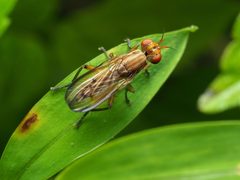
are medium-sized flies typical of the Sciomyzidae , with slender bodies, long legs, and elongated . The features large and with aristate structure. Wing venation includes characteristic patterns for the family, with a distinct anal and reduced crossveins. Coloration is generally muted, with grayish or brownish tones. Specific diagnostic features distinguishing T. vicina from require examination of genitalic structures and detailed chaetotaxy.
Habitat
Aquatic and semi-aquatic environments, particularly marshes, wetlands, and the margins of ponds and slow-moving streams. Larval development occurs in association with freshwater snails. are typically found in vegetation near water bodies.
Distribution
Distribution records are sparse. The has been documented in North America based on museum specimens. The primary is housed in the UCR Entomology Research Museum. iNaturalist records indicate 17 observations, though precise geographic coordinates are not detailed in available sources. The full extent of the species' range remains poorly characterized.
Diet
Larvae are or of freshwater snails (Mollusca: Gastropoda), a defining trait of the Sciomyzidae . feeding habits are poorly documented for this ; related species feed on nectar and honeydew.
Host Associations
- freshwater snails - /larval development dependent on snail
Life Cycle
Holometabolous development with , three larval instars, pupa, and stages. Larvae are aquatic or semi-aquatic, developing within or upon freshwater snails. Specific details of oviposition , larval instar duration, and sites for T. vicina are not documented.
Behavior
are likely and associated with emergent vegetation near water. Larval involves seeking out snail , with feeding strategies varying between and depending on and host. Specific behavioral observations for T. vicina are lacking.
Ecological Role
As a snail-killing fly, T. vicina contributes to regulation of freshwater snail . This functional role may influence aquatic and potentially affect snail-mediated processes such as algal grazing and nutrient cycling. The also serves as a food source for .
Human Relevance
Indirect relevance through ecological services in wetland . No direct economic or medical importance documented. The Sciomyzidae has been investigated for potential against pest snails, though specific applications involving T. vicina are not recorded.
Similar Taxa
- Tetanocera other species share similar external and require genitalic examination for separation
- Other Sciomyzidae genera-level characters in wing venation and general habitus, but differ in genitalic and chaetotaxic details
More Details
Taxonomic History
Described by Pierre-Justin-Marie Macquart in 1844, a prominent French dipterist. The has received limited modern taxonomic attention.
Type Specimen
Primary type housed at UCR Entomology Research Museum (UCRC ENT 00039164), with , lateral, , and label images available.
Research Status
Like many Sciomyzidae, detailed biological and ecological studies are lacking. The as a whole would benefit from focused revisionary and biosystematic work.