
Limnia
Robineau-Desvoidy, 1830
Species Guides
6- Limnia boscii(marsh fly)
- Limnia conica
- Limnia georgiae
- Limnia loewi
- Limnia shannoni
- Limnia sparsa(marsh fly)
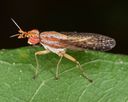
Limnia is a of flies in the Sciomyzidae (marsh flies or snail-killing flies). are malacophagous, with larvae that parasitize or prey upon pulmonate snails. The genus occurs across the West-Palearctic region, with some species extending into Asia. Larvae typically develop through three instars, with early instars acting as and later instars becoming or scavengers.
Pronunciation
How to pronounce Limnia: /ˈlɪmˌnaɪə/
These audio files are automatically generated. While they are not always 100% accurate, they are a good starting point.
Identification
Limnia are small to medium-sized sciomyzid flies. may be distinguished from related by genitalic characters and wing venation patterns; species-level identification often requires examination of male terminalia. Larvae are elongate, legless maggots that reach up to 10–12 mm in the final instar.
Images
Habitat
Wetland environments including lake margins, boggy microhabitats, waterlogged areas, and stands of emergent vegetation such as Carex acutiformis and Phragmites australis. frequent moist to wet ; larval development occurs within snail shells.
Distribution
West-Palearctic distribution, primarily Europe and Asia, extending eastward to China and reaching the southern fringes of Iran. The is most numerous within its European range, including Poland.
Seasonality
period occurs from May through October. with pupae.
Diet
Malacophagous. Larvae parasitize or consume pulmonate gastropods including freshwater snails (Lymnaea, Physa, Planorbis, Succinea) and land snails (Vertigo moulinsiana, Lauria cylindracea) as well as slugs (Deroceras reticulatum). First two larval instars are ; third instar becomes or scavenger.
Host Associations
- Vertigo moulinsiana - First documented record for Limnia unguicornis; vulnerable land snail
- Lymnaea spp. - Freshwater pulmonate snail
- Physa spp. - Freshwater pulmonate snail
- Planorbis spp. - Freshwater pulmonate snail
- Succinea putris - Semi-terrestrial pulmonate snail
- Lauria cylindracea - Land snail
- Deroceras reticulatum - Slug
Life Cycle
. fly May–October. Oviposition begins approximately 100 days after onset. up to 1 mm diameter hatch in 4–7 days. Three larval instars: first two are within snails, third instar (reaching 10–12 mm) becomes or scavenger. Larval development spans 20–30 days. occurs in outside the host body; pupae overwinter. Larvae typically complete development on a single host individual, with rare host-switching when hosts are too small.
Behavior
Larvae usually kill animals through feeding activity, causing reduced motility and death. The larva occupies the host shell completely, hidden from external view, and causes the host body to retract tightly. Host selection and penetration mechanisms remain unclear. Host-switching occurs rarely when primary host size is insufficient.
Ecological Role
and of pulmonate snails in wetland . Contributes to of wetland snail , including vulnerable . Represents a poorly documented component of terrestrial and freshwater - interactions.
Similar Taxa
- L. paludicolaMorphologically similar; taxonomic relationship unresolved; Vikhrev (2023) suggested possible conspecificity with L. unguicornis
Sources and further reading
- BugGuide
- Wikipedia
- iNaturalist taxon
- NCBI Taxonomy
- Catalogue of Life
- The first record the Limnia unguicornis (Diptera, Sciomyzidae) parasites on a vulnerable pulmonate land snail, Vertigo moulinsiana (Gastropoda: Eupulmonata: Vertiginidae) and a literature review on Limnia species
- Genome Sequence of “ Candidatus Nitrosoarchaeum limnia” BG20, a Low-Salinity Ammonia-Oxidizing Archaeon from the San Francisco Bay Estuary