
Amauromyza flavifrons
(Meigen, 1830)
A leaf-mining fly in the Agromyzidae, Amauromyza flavifrons is notable for documented cases of rapid evolutionary change in plant selection. have been observed to evolve avoidance toward novel hosts, specifically sugar beet (Beta vulgaris), when local exposure creates costs. This makes the a studied example of contemporary evolution in plant-insect interactions.
Pronunciation
How to pronounce Amauromyza flavifrons: /əˌmɔːrəˈmaɪzə ˈflævɪfrɒnz/
These audio files are automatically generated. While they are not always 100% accurate, they are a good starting point.
Images
Distribution
Recorded from Belgium, Denmark, Norway, and Sweden. Distribution records indicate presence in the Flemish Region of Belgium.
Host Associations
- Beta vulgaris - AVOIDED_HOSTSugar beet; near sugar beet farms show evolved avoidance , while sugar beet-free populations readily oviposit on this plant. The avoidance appears to have evolved in response to costs associated with this novel .
Behavior
Females exhibit oviposition discrimination that varies by : flies from areas without sugar beet farms readily oviposit on Beta vulgaris, whereas those from populations near sugar beet farms discriminate against this . This represents one of the first documented cases of host-avoidance evolution in the wild.
Ecological Role
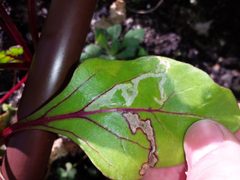
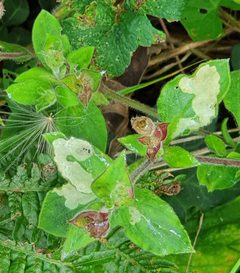
; larval feeding creates mines in leaf tissue. -level variation in use suggests potential for rapid to local plant .
Similar Taxa
- Amauromyza karliCongeneric stem-boring fly; differs in (stem-boring vs. leaf-mining) and associations, though both are agricultural pests with yellow coloration on .
Sources and further reading
- BugGuide
- GBIF taxonomy match
- iNaturalist taxon
- NCBI Taxonomy
- Look Out, Franklin's Bumble Bee, They're Coming for You! | Bug Squad
- Bug Squad
- A Bumble Bee to Remember | Bug Squad
- Amauromyza karli adult - Entomology Today
- Amauromyza karli larva - Entomology Today
- Amauromyza karli pupa - Entomology Today
- Evolution of host avoidance in a leafmining fly, Amauromyza flavifrons
- Genetic Variation and the Potential for Host Range Evolution in the Leafmining Fly Amauromyza flavifrons (Diptera: Agromyzidae)