
Prosenoides
Brauer & Bergenstamm, 1891
Species Guides
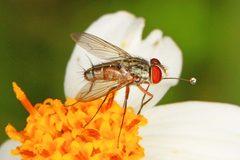
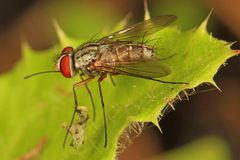
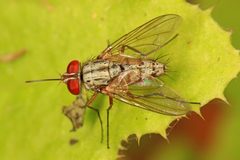
2Prosenoides is a of tachinid flies established by Brauer and Bergenstamm in 1891. The genus comprises 12 described distributed across the Americas. As members of the Dexiini tribe, these flies are , though specific records for most Prosenoides species remain poorly documented.
Pronunciation
How to pronounce Prosenoides: //ˌprɒsɛˈnɔɪdiːz//
These audio files are automatically generated. While they are not always 100% accurate, they are a good starting point.
Identification
Prosenoides can be distinguished from related dexiine by the combination of a curved and characteristic leg coloration patterns, including notably yellow or pale legs in some species (e.g., P. flavipes). The genus is morphologically similar to Prosena but differs in details of facial structure and wing venation. Species-level identification requires examination of male terminalia and comparison of .
Images
Distribution
of Prosenoides occur in the Americas, with records from North, Central, and South America. Specific country-level distributions vary by species; for example, P. flavipes is known from the United States, while P. tenuipes was described from material collected in South America.
Ecological Role
As tachinid flies, Prosenoides function as , likely attacking other insects. Their ecological role in natural and agricultural systems has not been specifically studied.
Similar Taxa
More Details
Taxonomic History
The was established by Brauer and Bergenstamm in 1891. Most were described in the mid-20th century by Reinhard (1954) and others, with some species transferred from other genera (e.g., P. curvirostris from Bigot's 1889 Tachina curvirostris).
Nomenclatural Notes
The feminine epithets in some Prosenoides species (e.g., P. haustellata, P. longilingua, P. trilineata) reflect original combinations in feminine before transfer to the masculine Prosenoides, where they should grammatically end in -us; however, these original spellings are maintained under ICZN Article 31.2.3 for species-group names established as nouns in apposition.